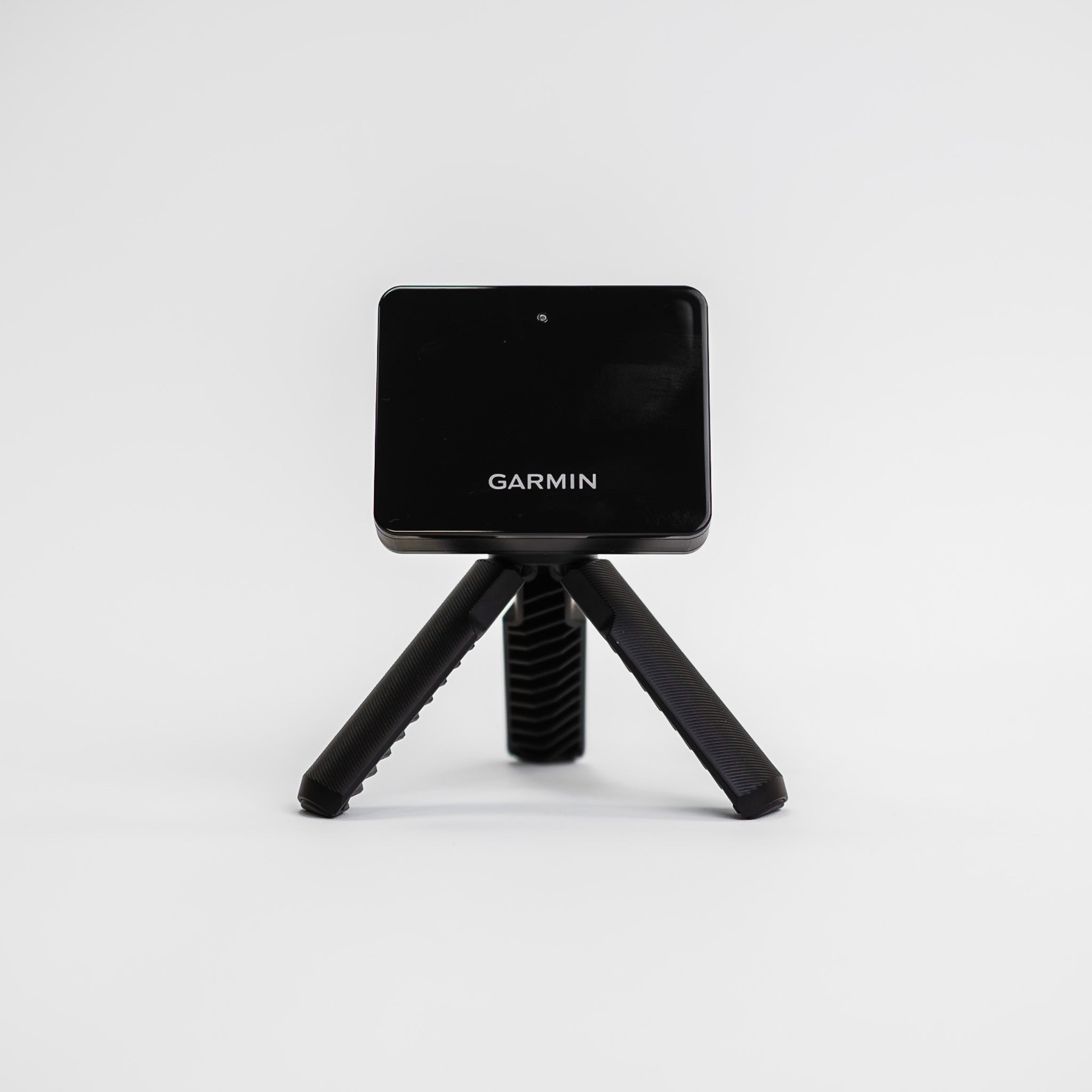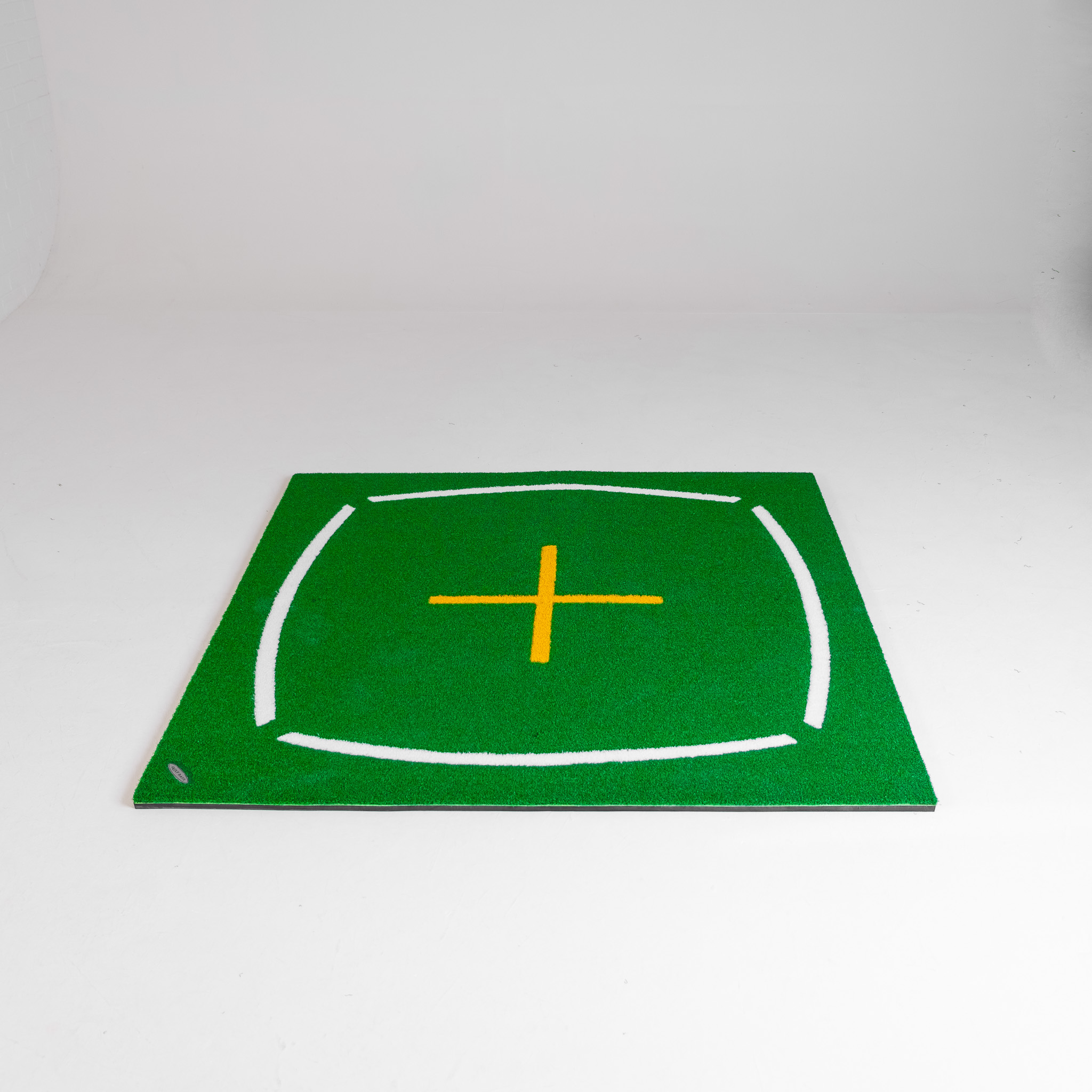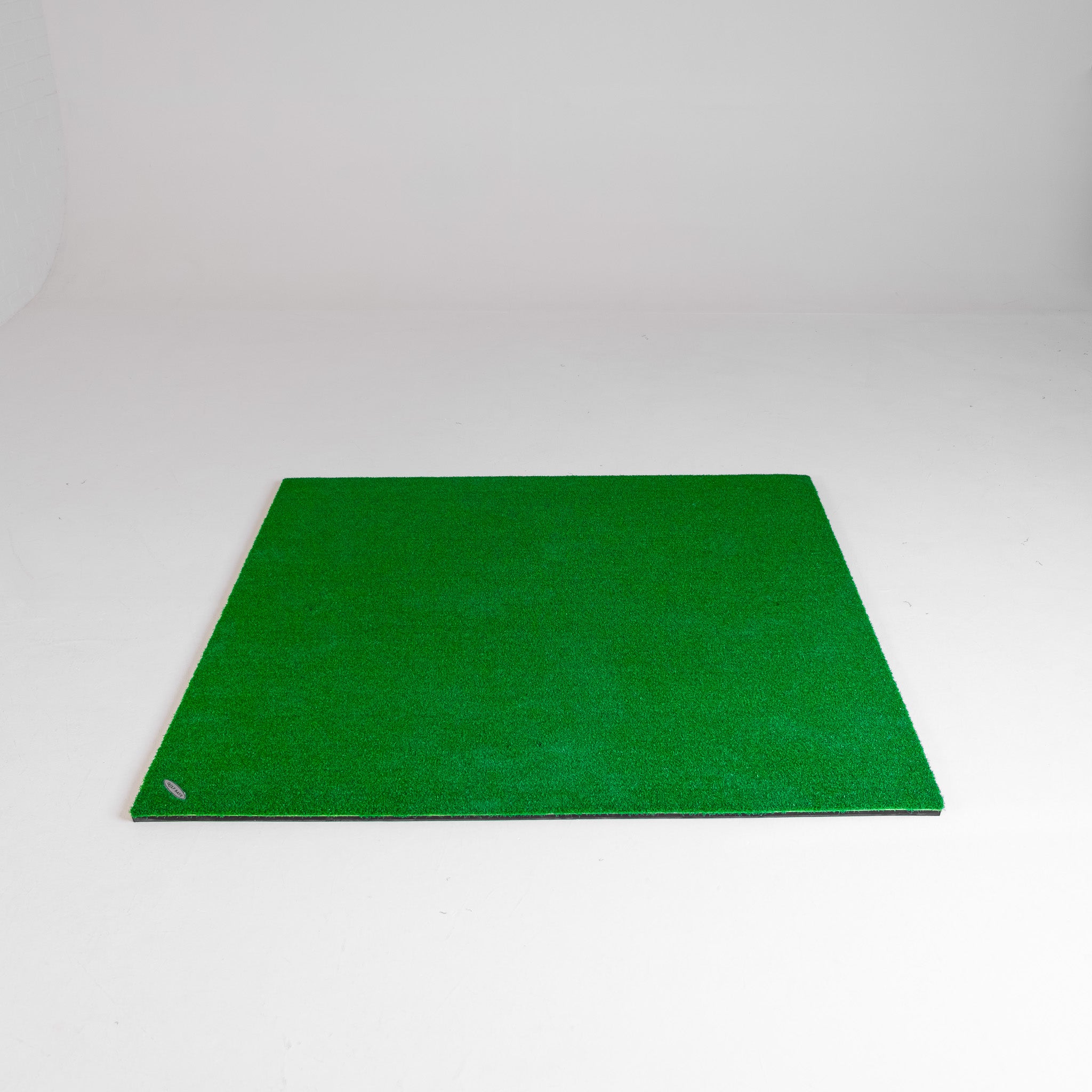


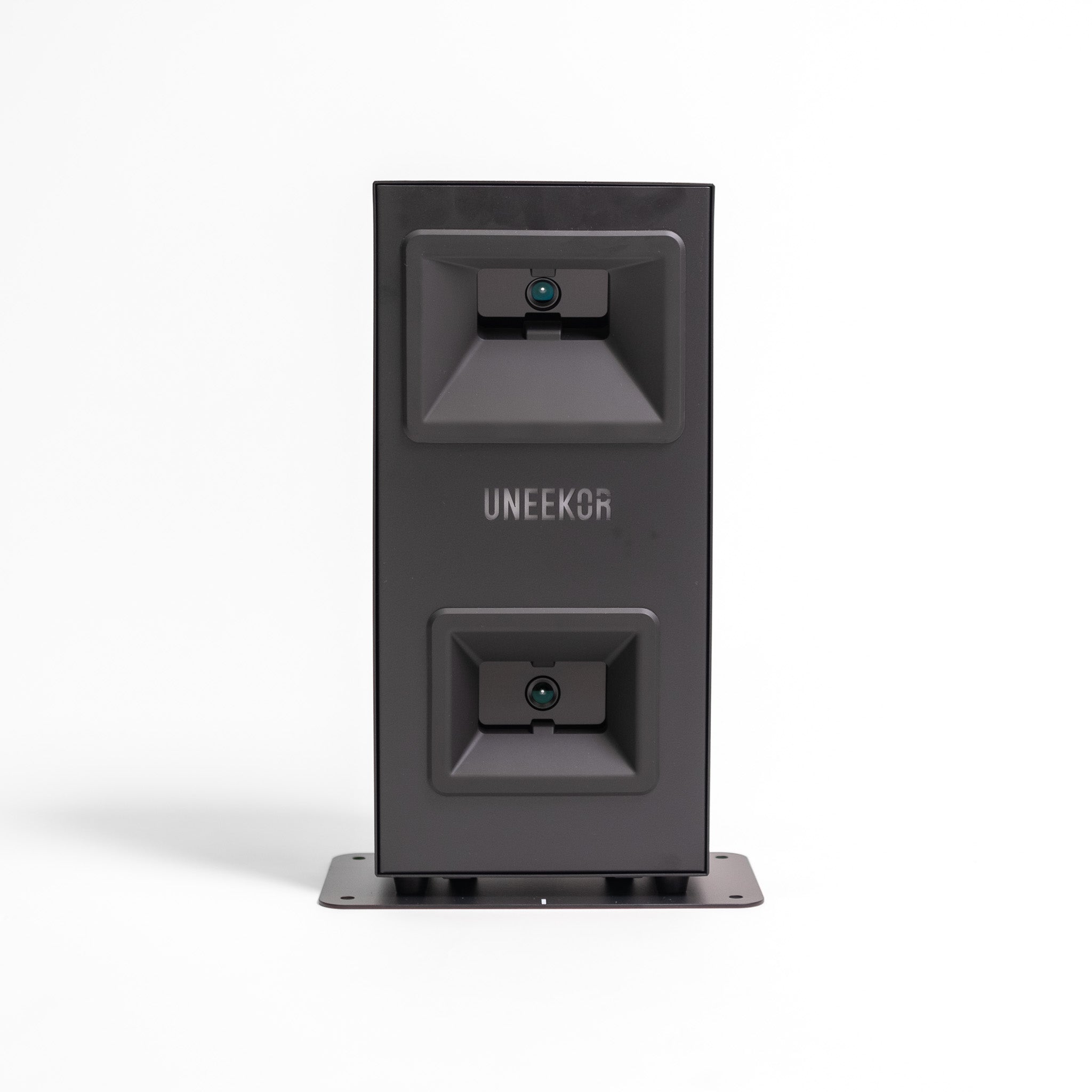
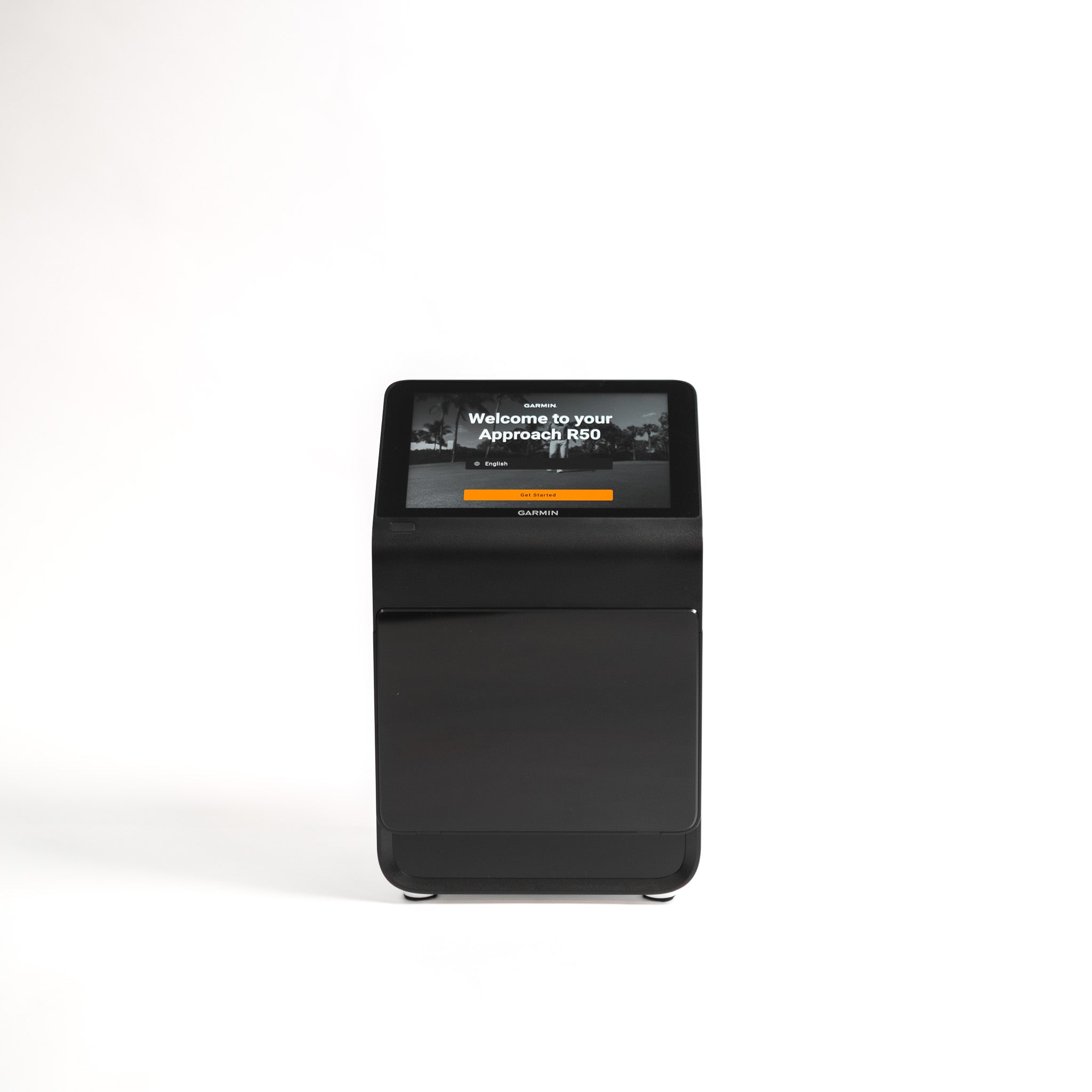









The garage is the obvious room for a golf simulator, not least because it has a door you can shut on the mess. It's also cold, damp in winter, often too low and usually full of car. Here's how to check yours fits, what to do about the door, the damp and the heat, and what we'd put in a single or a double garage.
Quick summary
- A full driver swing needs a garage about 2.8m high, 3m wide and 4.5m deep with a camera launch monitor beside the ball, or 5m deep with a radar unit behind you.
- Measure the height with the door open, because up-and-over and sectional doors lie under the ceiling when they're up, and an electric opener adds a rail and a motor.
- Damp is what hurts the kit, so heat the garage gently, run a dehumidifier and keep the launch monitor and the laptop in the house.
- If the car still has to fit, a net, a mat and a launch monitor pack away after every session and the Vanish 11 enclosure retracts to the ceiling. A SimBox frame goes up without tools in under an hour, which is fine once a season but not every night.
- Our cheapest complete garage bay is the Square Golf EasySim package at £1,649, and £3,098.98 buys it with a mat, a floor-standing projector and acoustic tiles.
Can you put a golf simulator in a garage?
Yes. A garage usually has more floor than a spare room or a loft bay, a concrete slab that suits a hitting mat, and walls you won't mourn if a mishit finds them.
What goes wrong in a garage is just as predictable. 4 things decide whether yours works:
- Height: the ceiling, and everything that hangs from it, including the door when it's open.
- Damp and cold: electronics left in an unheated garage through a British winter get wet in ways they don't in the house.
- Power: a garage wired for a freezer and a drill won't always run a projector, a PC and a heater as well.
- The car: if it still lives in there, the bay has to pack away or lift out of the way.
Get those 4 right and a garage beats every other room in the house, bar one built for the job.
How big does a garage need to be for a golf simulator?
For a full swing with a driver, about 2.8m high, 3m wide and 4.5m deep with a camera launch monitor beside the ball, or 5m deep with a radar unit behind you. The enclosure takes less than that; the rest is room for you to swing.
| Setup | The enclosure itself | Garage for a full driver swing |
|---|---|---|
| Square Golf EasySim, camera beside the ball | 3.3m wide, 2.5m high, 1m deep | 3.3m wide, 2.8m high, 4.5m deep |
| SimBox with a camera launch monitor | 2.6m to 4m wide, 2.5m to 3m high | 3m wide, 2.8m high, 4.5m deep |
| SimBox with a radar launch monitor | 2.6m to 4m wide, 2.5m to 3m high | 3m wide, 2.8m high, 5m deep |
| Vanish 11, hung from the ceiling | 11ft (about 3.4m) front screen | Wider than the screen, 2.8m high, 4.5m or 5m deep |
Height decides the most, and it's the one thing in a garage you can't easily change. Under a 2.4m ceiling you're 40cm short of the 2.8m we plan on for a driver, so expect to hit irons and wedges. Every SimBox and EasySim frame is at least 2.5m tall, so a garage lower than that takes a practice net rather than one of those enclosures.
Width is measured at the hitting position, wall to wall, after the shelves, the freezer and the bikes have had their say. 3m gives a right-hander room to swing with the ball in the middle of the bay, and a left-hander the same once a camera unit swaps sides.
Depth runs from the back wall, where the screen goes, to the inside of the garage door. The enclosure takes the first 1m for an EasySim or 1.5m for most SimBox sizes, the ball sits out in front of it, and whatever's behind you is room for the backswing and, with radar, the launch monitor.
How do you measure a garage for a golf simulator?
With the garage set up the way you'll use it: door open, car out, and everything that lives in there still in it. 5 checks, in this order.
1. Open the door and measure under it. Take the height from the floor to the underside of the open door, its tracks, the opener rail and the motor, wherever they sit over the space you'll swing in.
2. Find the lowest point above the mat. Beams, joists, pipes, a strip light and the loft hatch all count. Measure where the club goes, not at the highest point of the roof.
3. Measure the width at the hitting position. Go wall to wall, then take off anything fixed to the walls: shelving, the boiler, the consumer unit, which has to stay reachable, and the door into the house.
4. Measure the depth to the door. Go from the back wall to the inside of the closed door, then take off whatever has to stay at the back, such as the freezer or the workbench.
5. Swing the driver, slowly. From where the mat will go, with the door open, take it to the top and through to the finish. Whatever the club touches going slowly, it will hit when you swing for real.
GolfBays tip
Before you order anything, mark the mat and the enclosure's footprint on the floor with masking tape. Open the door, put the car where it lives, and walk round it all for a week. Most of the questions answer themselves, and the freezer usually loses.
Which garage doors get in the way?
The ones that end up inside. A garage door has to go somewhere when it opens, and most types go up and back under the ceiling, which is exactly where your club wants to go.

| Door | Where it goes when it opens | What it means for the bay |
|---|---|---|
| Up-and-over, canopy | Swings up and hangs under the ceiling, with part of it outside as a canopy | The lowest point is near the door, so keep the swing further in |
| Up-and-over, retractable | Slides right back inside on tracks under the ceiling | All of the door lies further into the garage, over whatever is below it |
| Sectional | Panels run up and lie flat under the ceiling on tracks | The tracks stay put even when the door is shut |
| Roller | Coils into a drum above the opening | Only the drum box takes headroom, right by the door |
| Side-hinged | Swings outwards onto the drive | No headroom lost inside at all |
An electric opener on an up-and-over or sectional door adds a rail along the ceiling and a motor at the far end of it, and the motor usually sits further into the garage than the open door does. It's the part people forget to measure.
If the door gear hangs over where you'll swing, you have 3 options:
- Play with the door shut. A closed canopy door takes no headroom at all, although tracks and opener rails stay where they are.
- Move the bay back. With the screen on the back wall and the mat as close to it as the enclosure allows, the swing often ends up clear of the door gear.
- Change the door. A garage door firm can swap an up-and-over door for a roller door, which keeps everything in a box above the opening.
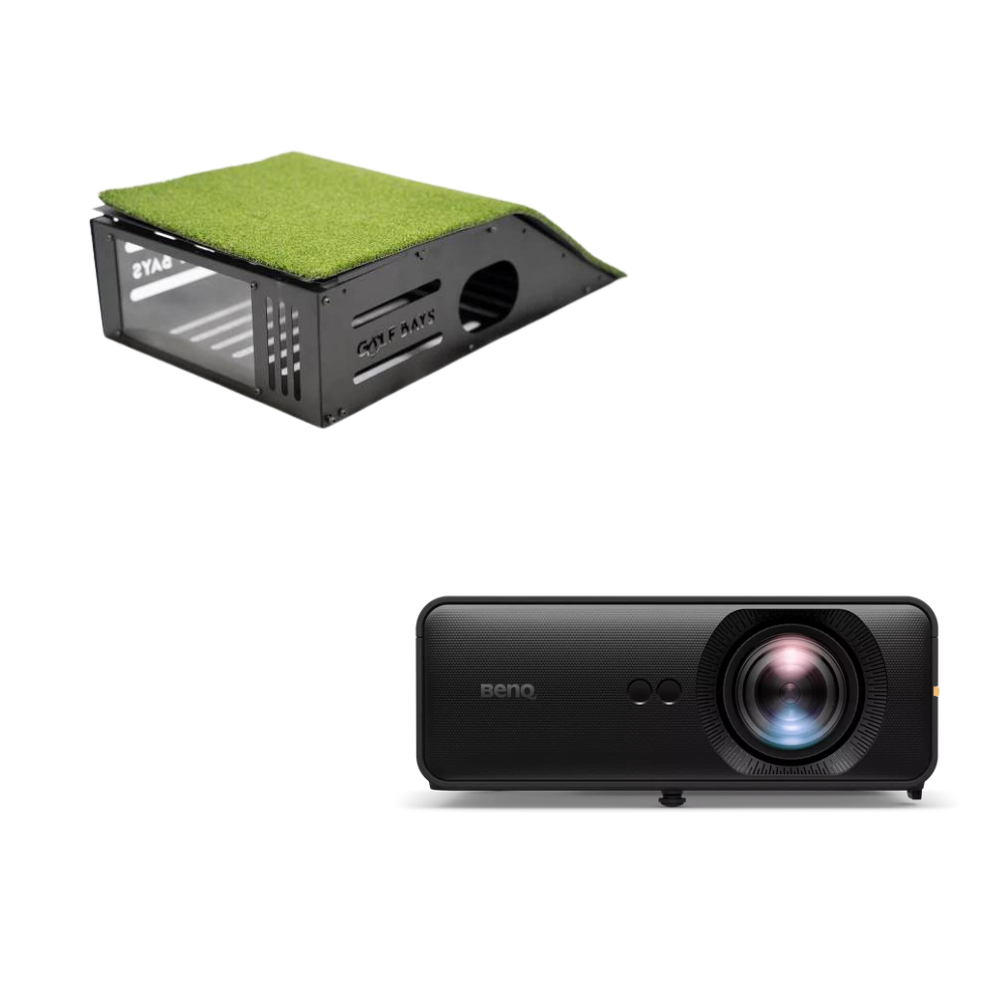
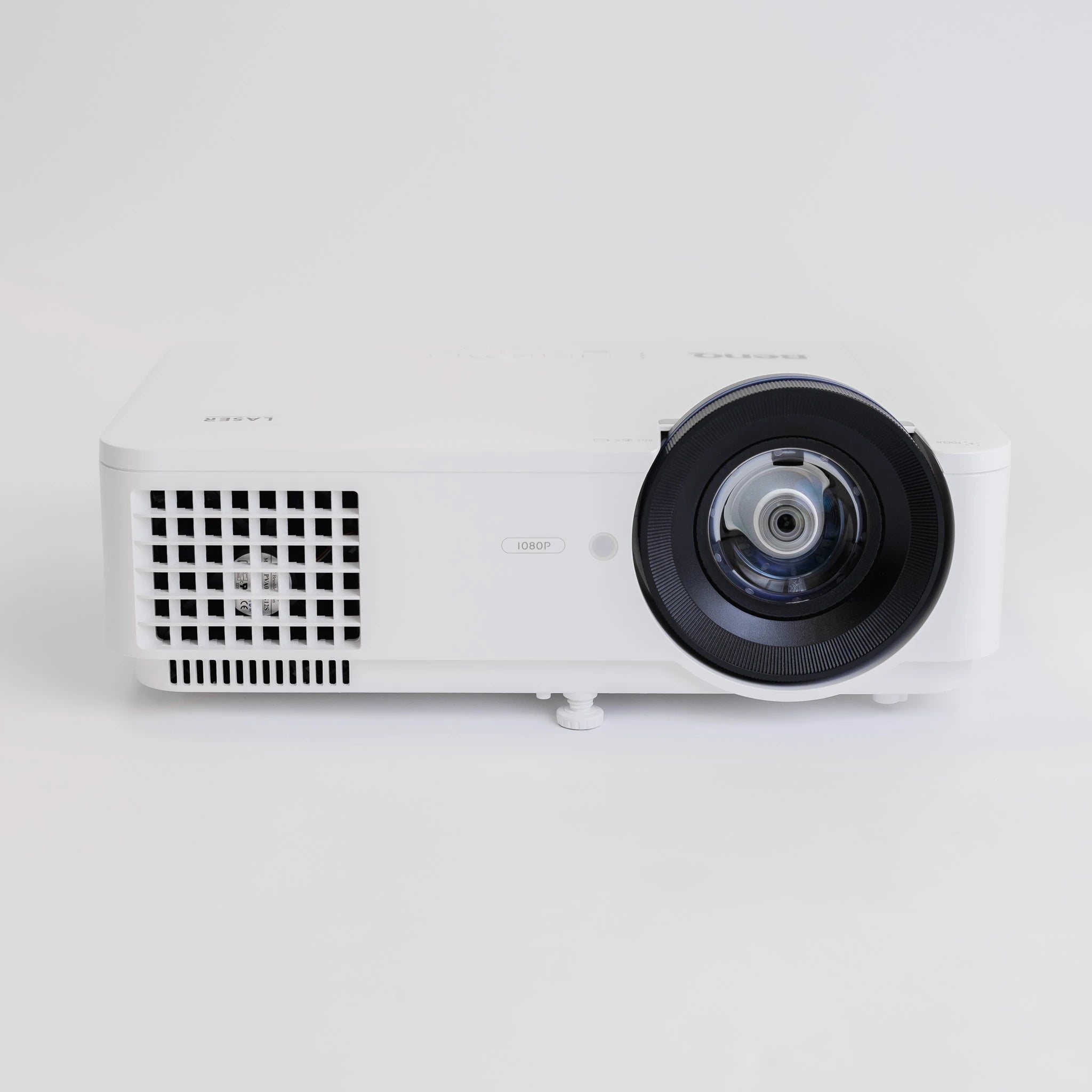
The door matters for the projector too. A short throw projector on the ceiling hangs near the front of the enclosure, towards the tee, and if that's where the opener rail runs or the open door ends up, the projector goes on the floor instead.

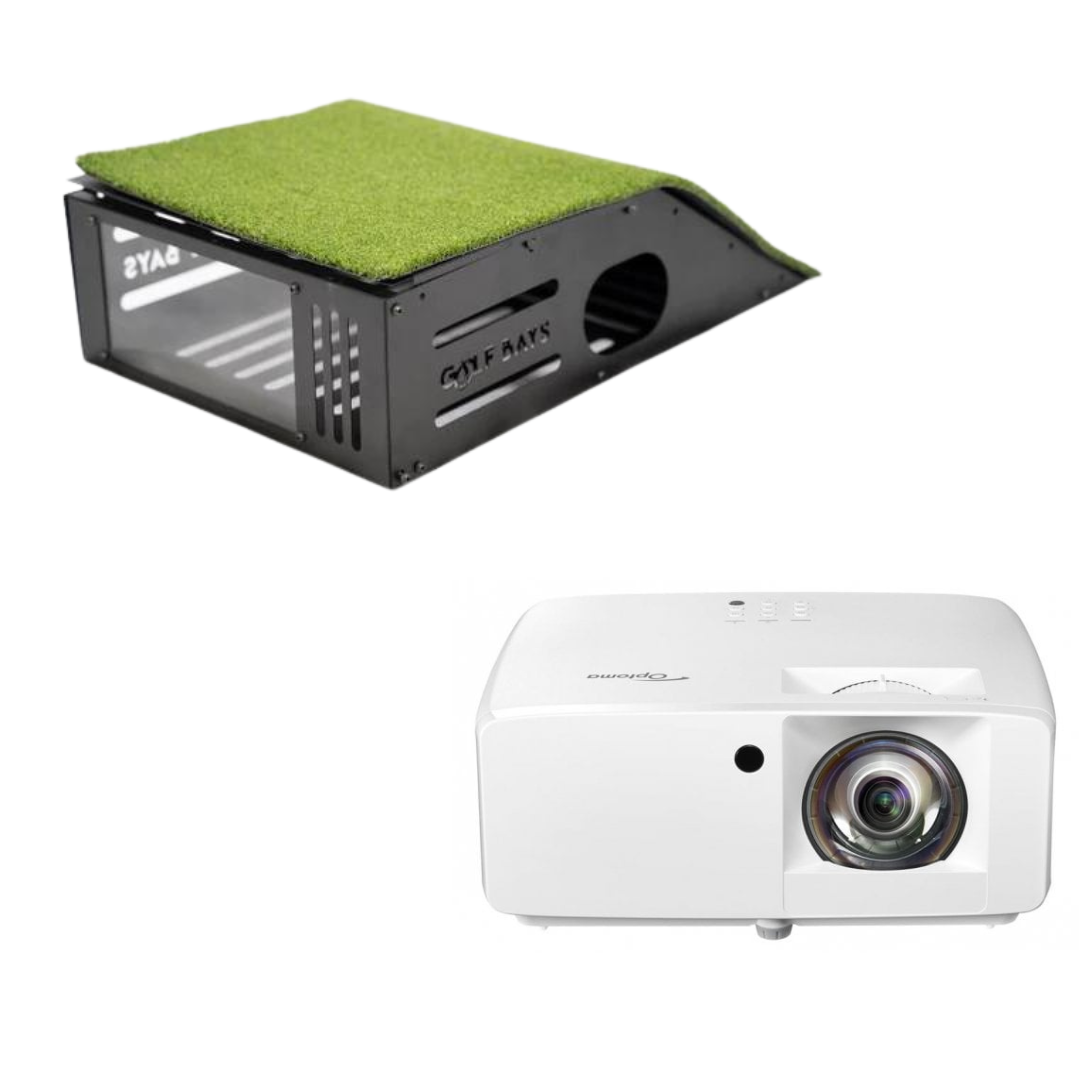
The Optoma ZH350ST with a floor case is £1,100 for a full HD laser projector and the steel case it lives in. The case sits on the floor by the tee with turf on its sloping top, so a low shot rolls over it, and the projector's 3,500 lumens reach the screen without anything hanging from the ceiling.
✓ Do this
Screen on the back wall, mat as close to it as the enclosure allows, and hit away from the door. The projector goes on the ceiling clear of the door gear, or on the floor in a case.
✕ Not this
Bay pushed towards the door to make room for the freezer, with the projector bolted to the ceiling right where the open door or the opener rail comes back over it.
Can you still park the car in the garage?
Sometimes. It depends on which parts of the bay have to stay up, and most of them don't. This is what moves and what doesn't.
| Part | Packs away? | How |
|---|---|---|
| Practice net | Yes | The TrueStrike TS-5 weighs about 7.3kg and moves to the side wall |
| Hitting mat | Yes | Slides or lifts to the wall; a heavy mat is a job for 2 |
| Launch monitor and laptop | Yes | Carried into the house after every session, which also keeps them dry |
| Vanish 11 enclosure | Retracts | Winds up to its ceiling brackets by hand crank or remote control |
| SimBox or EasySim frame | Comes down, but not every night | Aluminium tubes that click together; a SimBox goes up without tools in under an hour |
| Projector | Stays, or moves on the floor | Fixed on a ceiling mount, or in a floor case you can slide aside |
| Tiles, lights and sockets | Stay | On the walls and ceiling, out of the car's way |
So if the car goes back in every night, the realistic setups are a net that moves or an enclosure that lifts. A SimBox or an EasySim is for the garage where the car has moved out for good, or at least for the winter.
Whatever you choose, the car comes out before the golf starts. A club, a ricochet and a wing mirror are an expensive combination.
What fits a single garage?
In a single garage, the width at the hitting position and whether the car comes back in decide which of these fits. These are the 3 we'd look at, in order.
SkyTrak ST+ SimBox package: a garage 3m wide

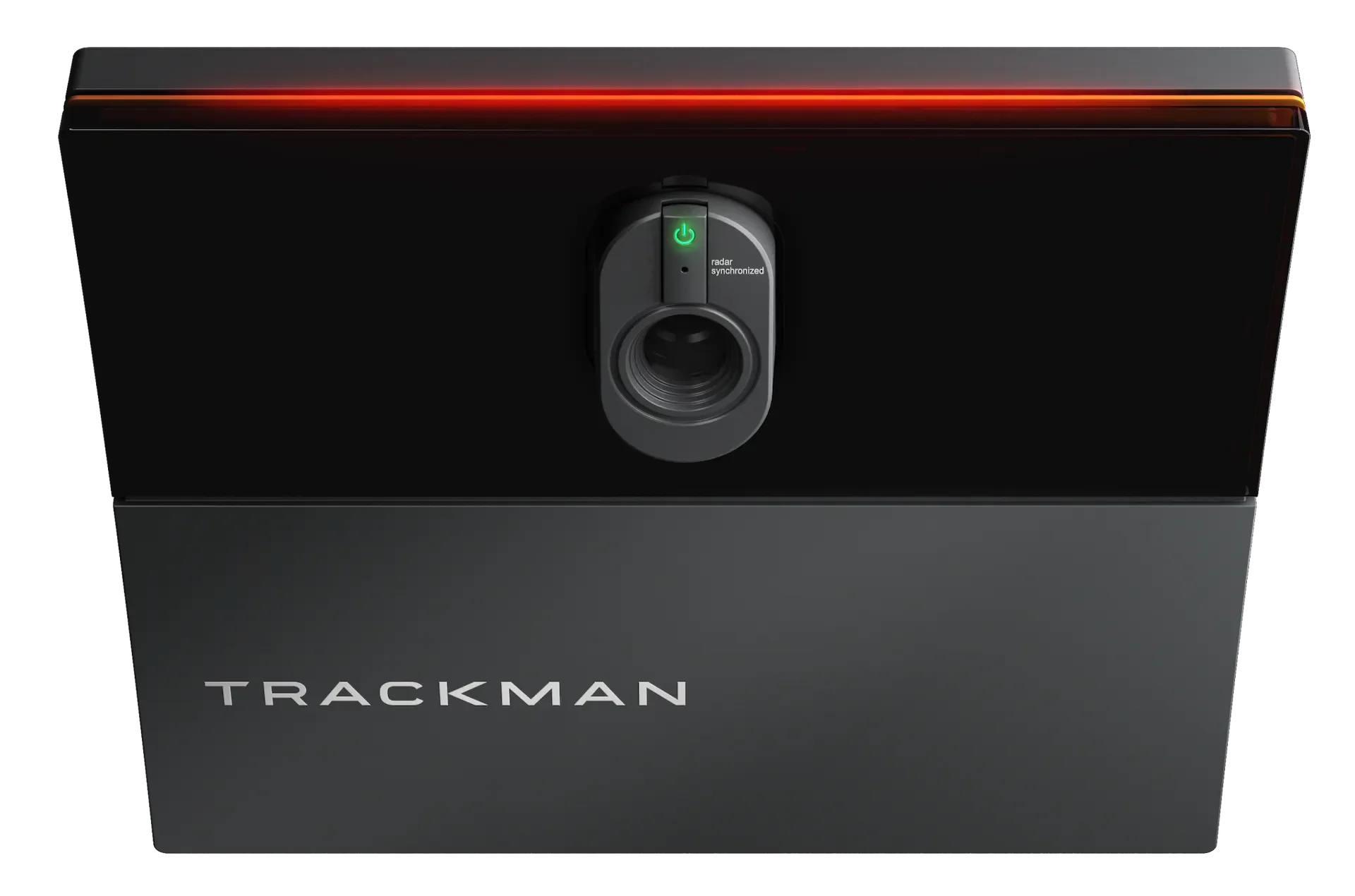
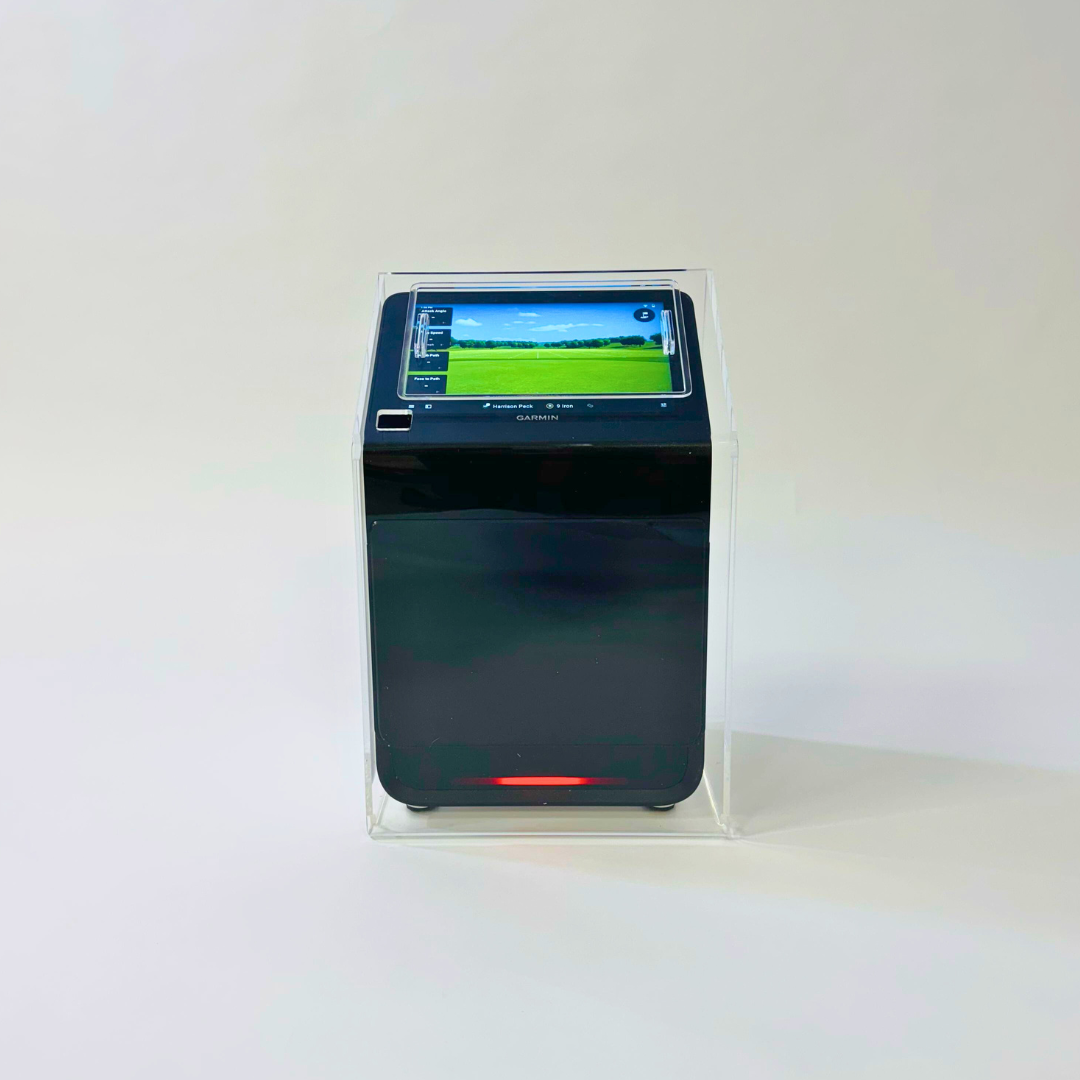
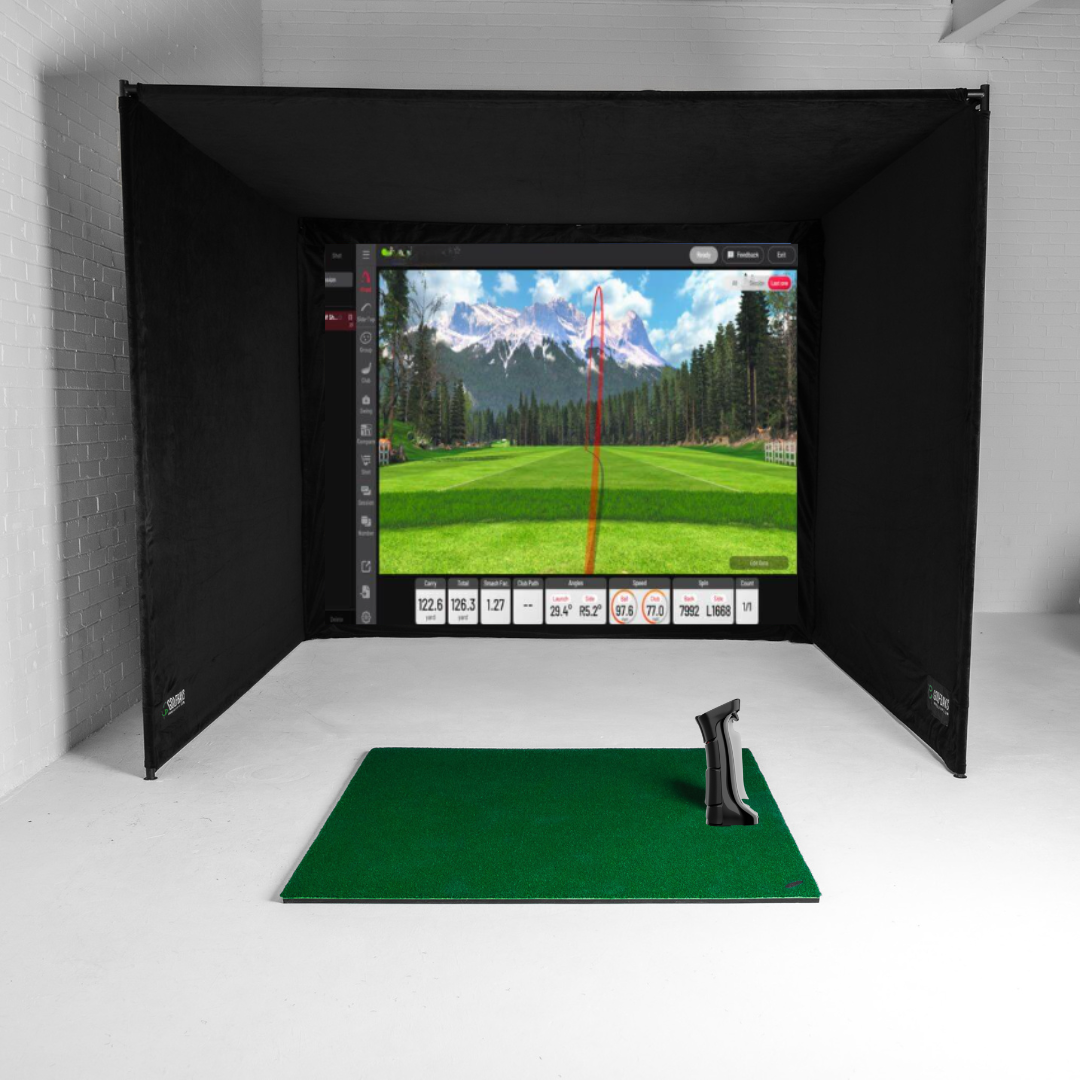
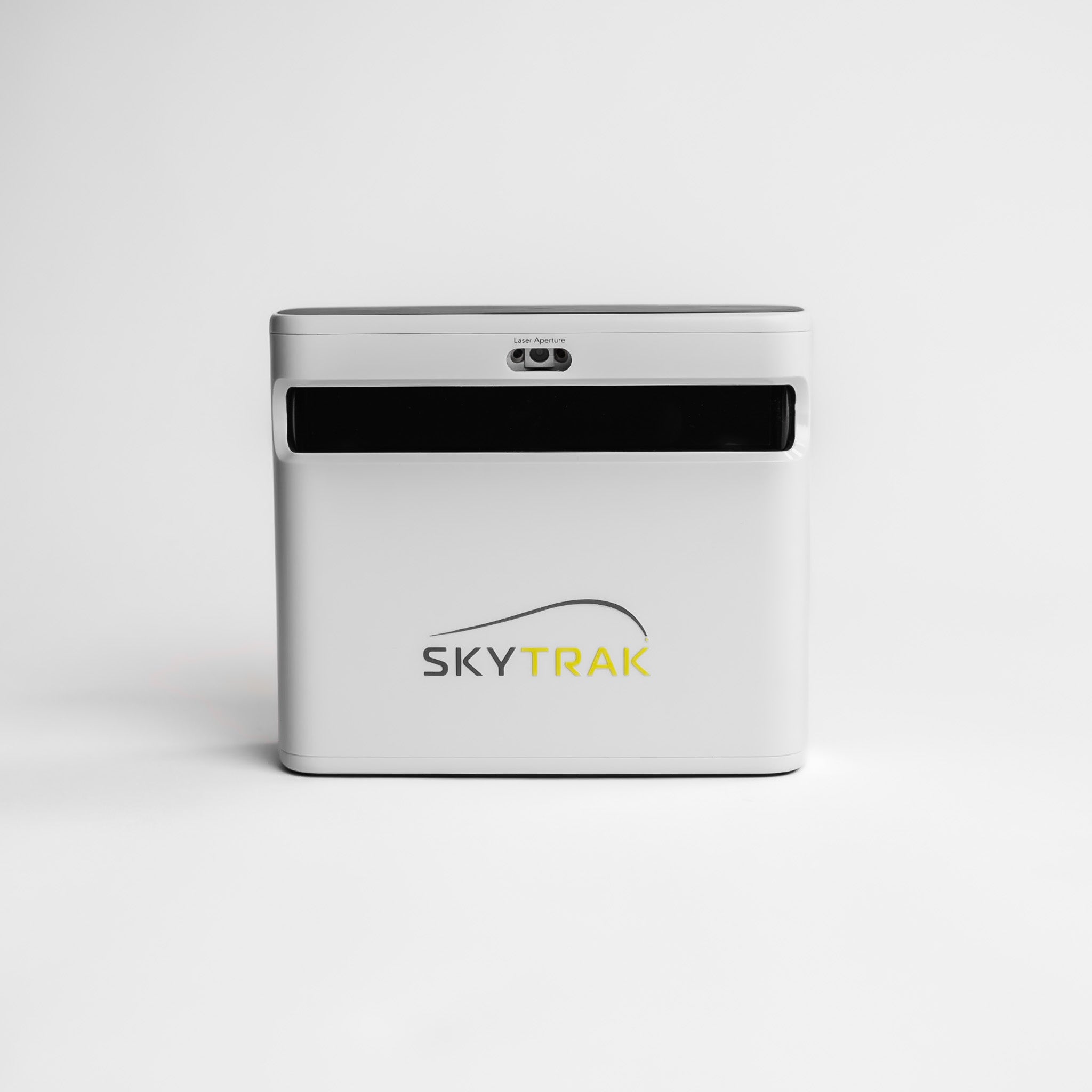
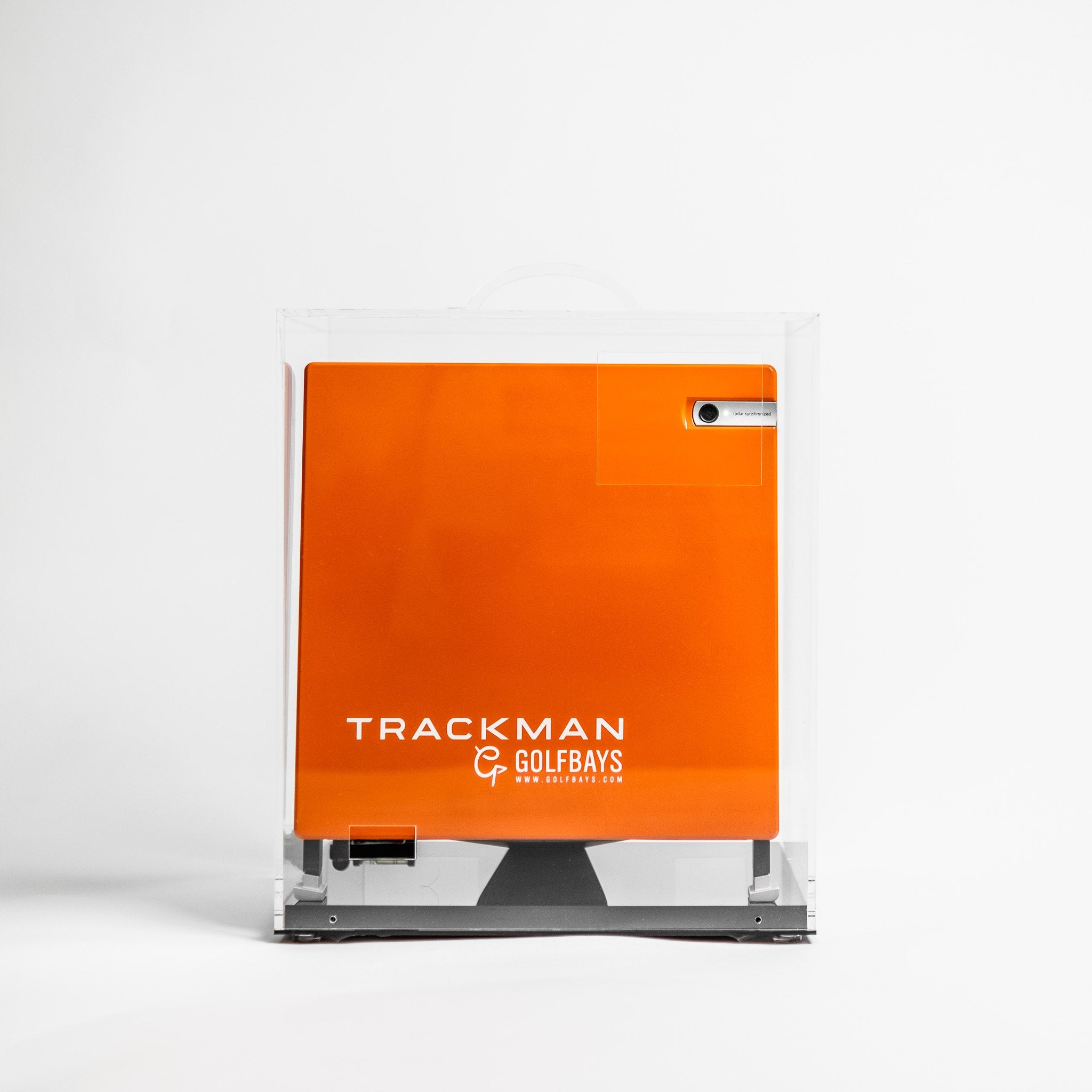
If the garage is at least 3m wide and 2.8m high, this is where we'd start. Its launch monitor sits beside the ball and reads the ball and the club with cameras and dual Doppler radar, so nothing has to go behind you and 4.5m of depth is enough.
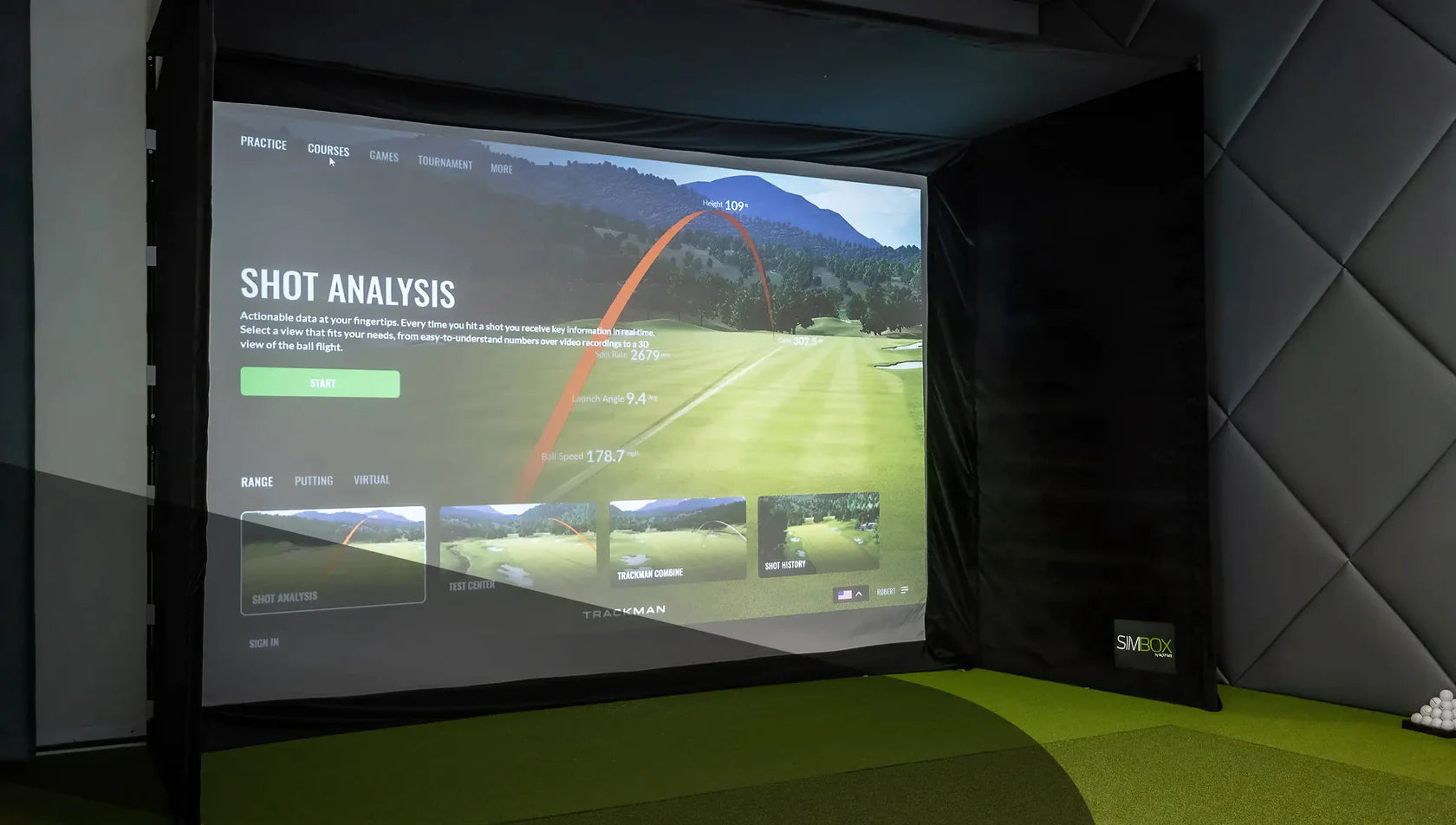
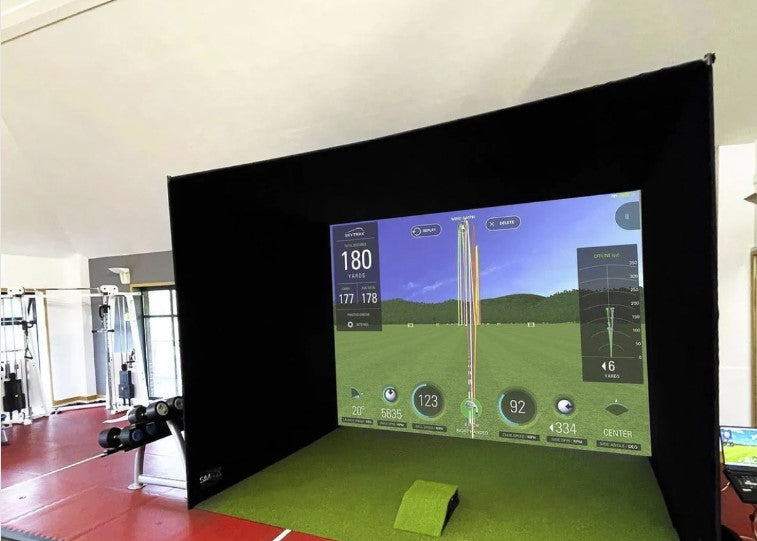
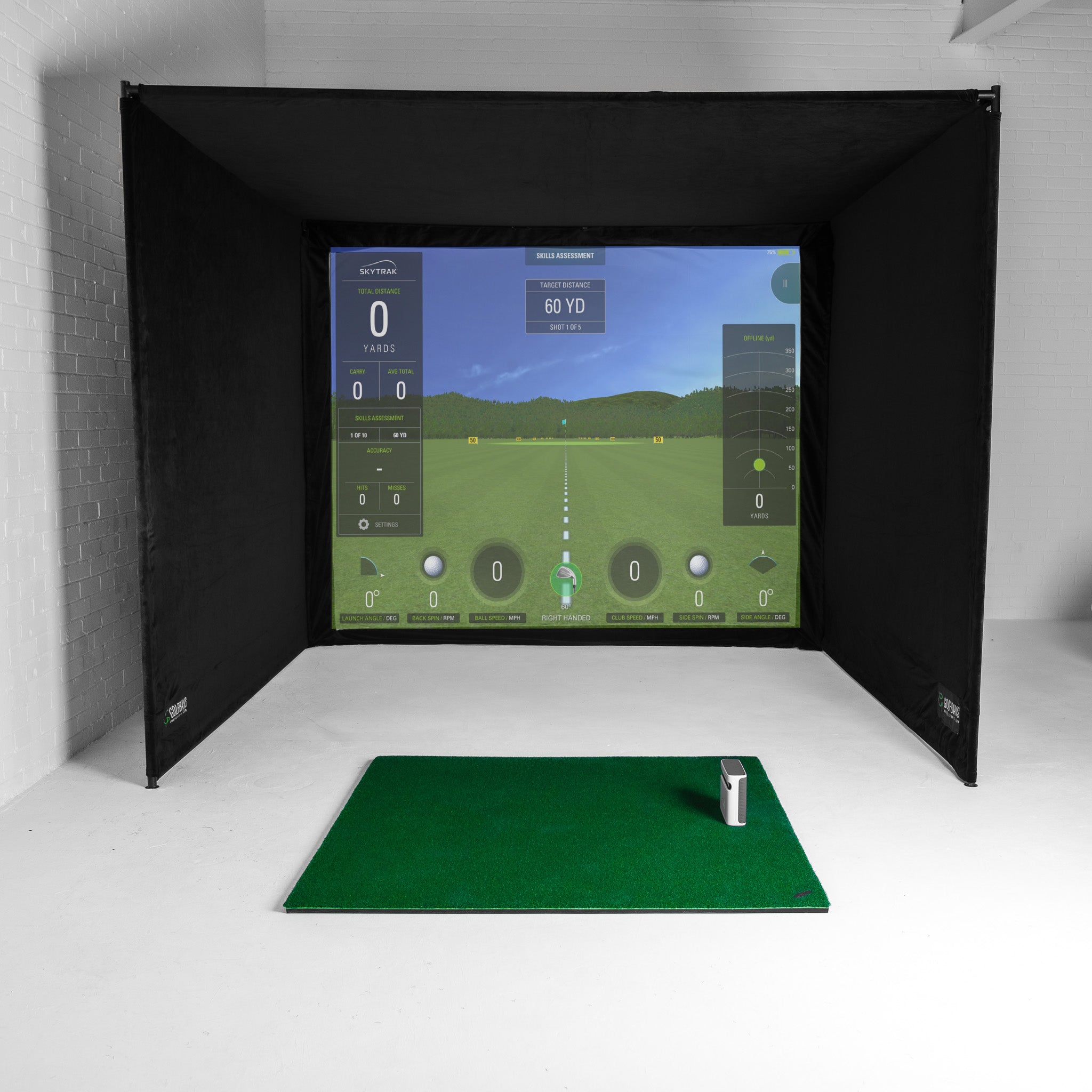
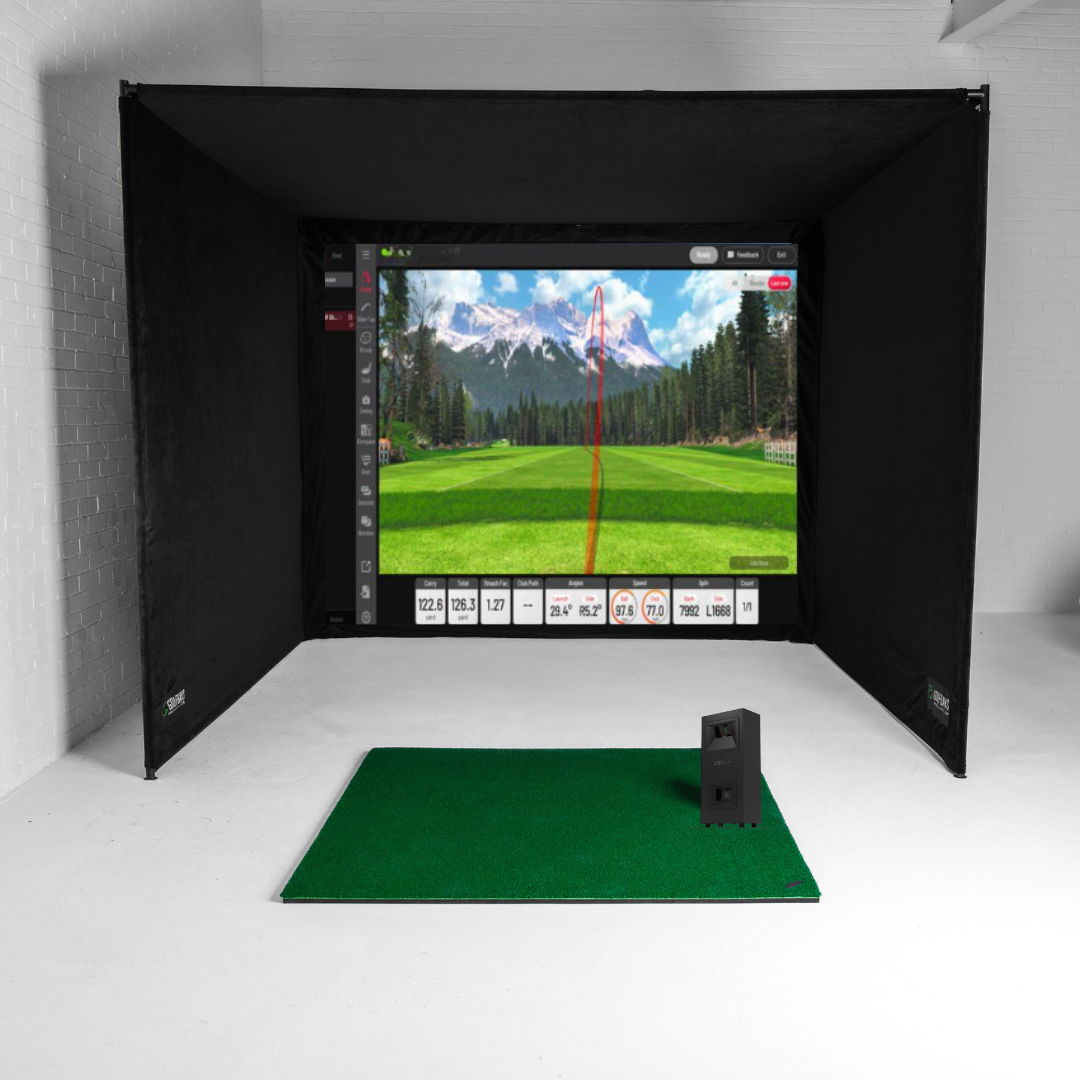
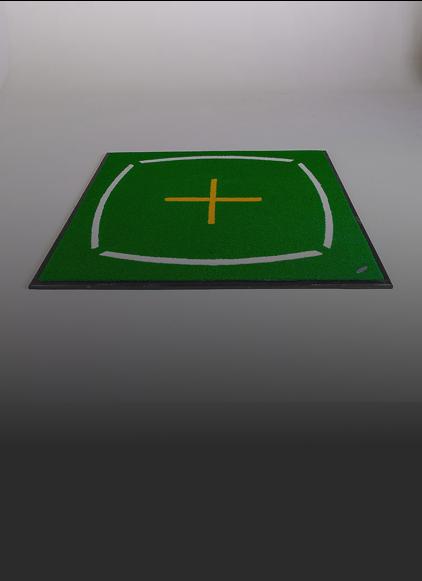
The SkyTrak ST+ SimBox package puts it in a SimBox frame with a Pro+ impact screen and our Standard 1.5m hitting mat, for £2,490 in the 2.6m width or £2,540 at 3m. The aluminium frame clicks together without tools, and the frame and fabric fold down for storage when the garage needs its floor back.
The catch: it needs the height. Every SimBox frame is at least 2.5m tall, so a 2.4m garage can't take one, and after the first year SkyTrak's courses are a membership at £249.99 a year.
Square Golf EasySim package: the cheapest complete bay

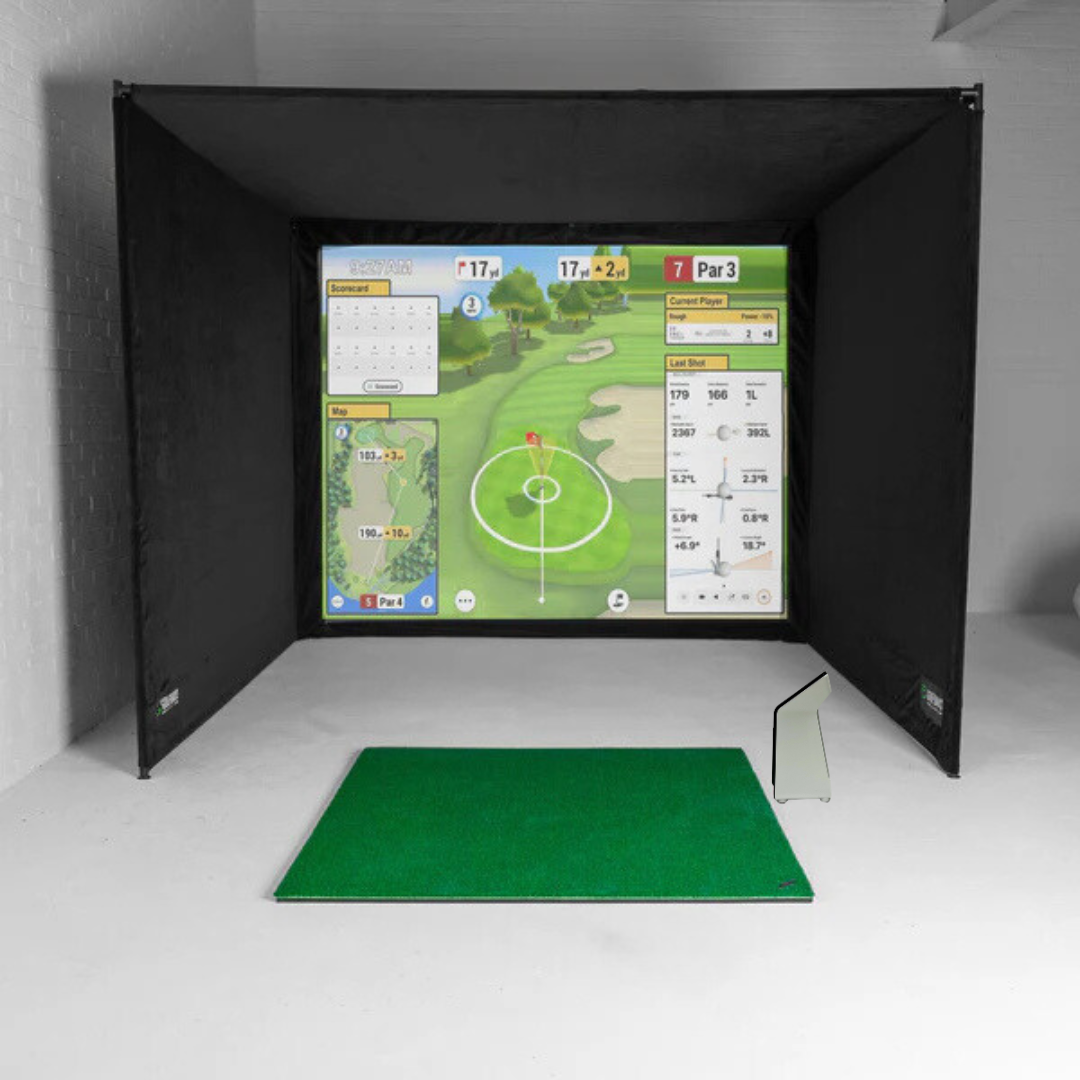
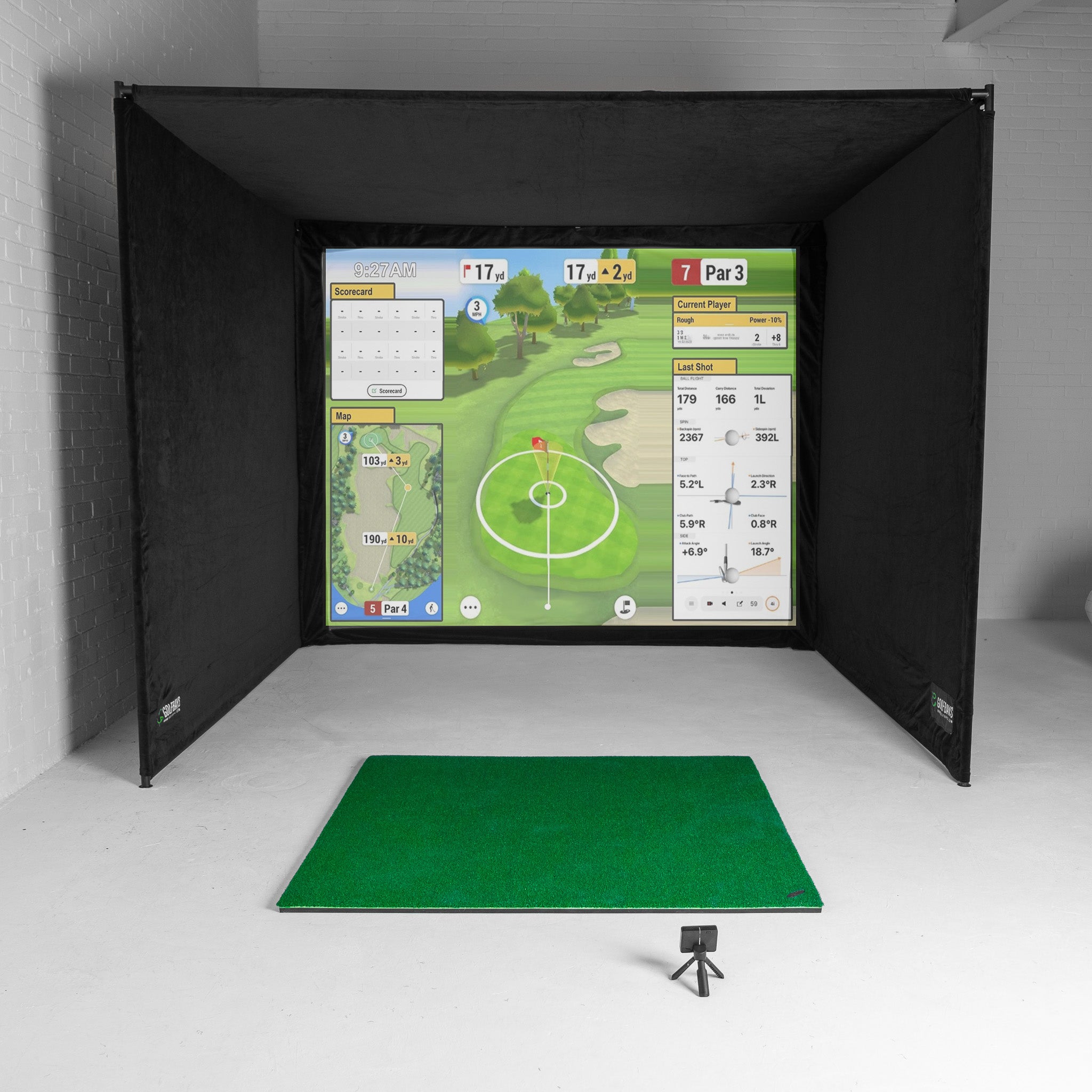
No complete simulator we sell costs less than the Square Golf EasySim package: £1,649 for Square Golf's camera launch monitor in our EasySim enclosure with its Lite impact screen, or £1,849 with a hitting mat as well. The enclosure takes just 1m of the garage's depth, at 3.3m wide and 2.5m high, and it arrives with its poles, black fabric surround and screen.
The Lite screen is made for a quiet impact, which is why this is the bay we'd pick when the garage wall is also next door's wall. The launch monitor reads the ball and the club from beside the mat, so nothing has to go behind you in a short garage.
The catch: it comes in one size, and at 3.3m wide it needs a garage at least that wide inside, wall to wall.
TrueStrike TS-5 net and Square Golf launch monitor: a bay that packs away
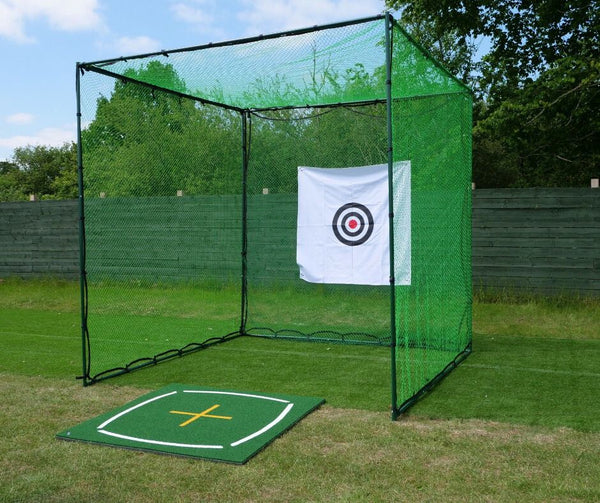
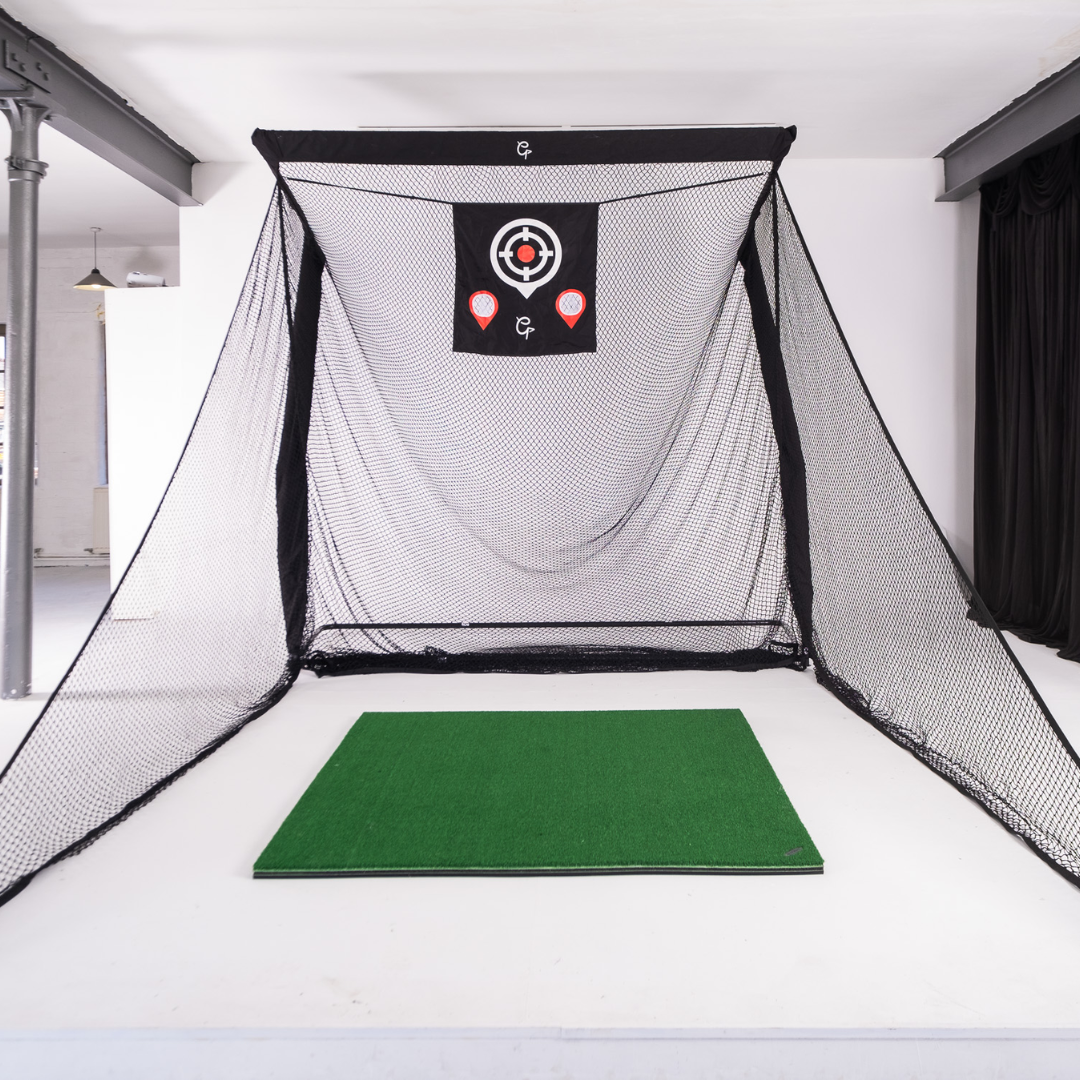
When the car goes back in every night, skip the enclosure and hit into a net.

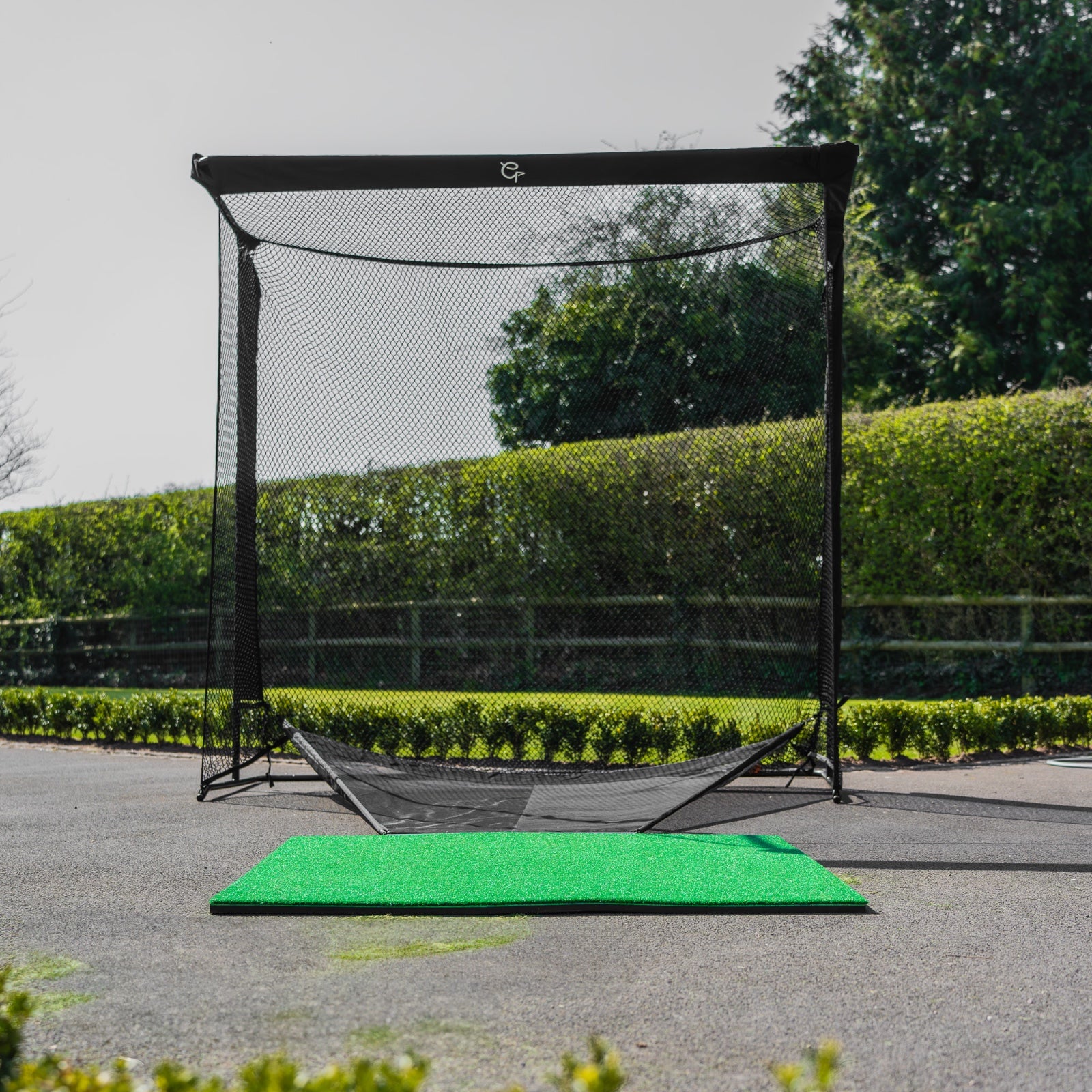
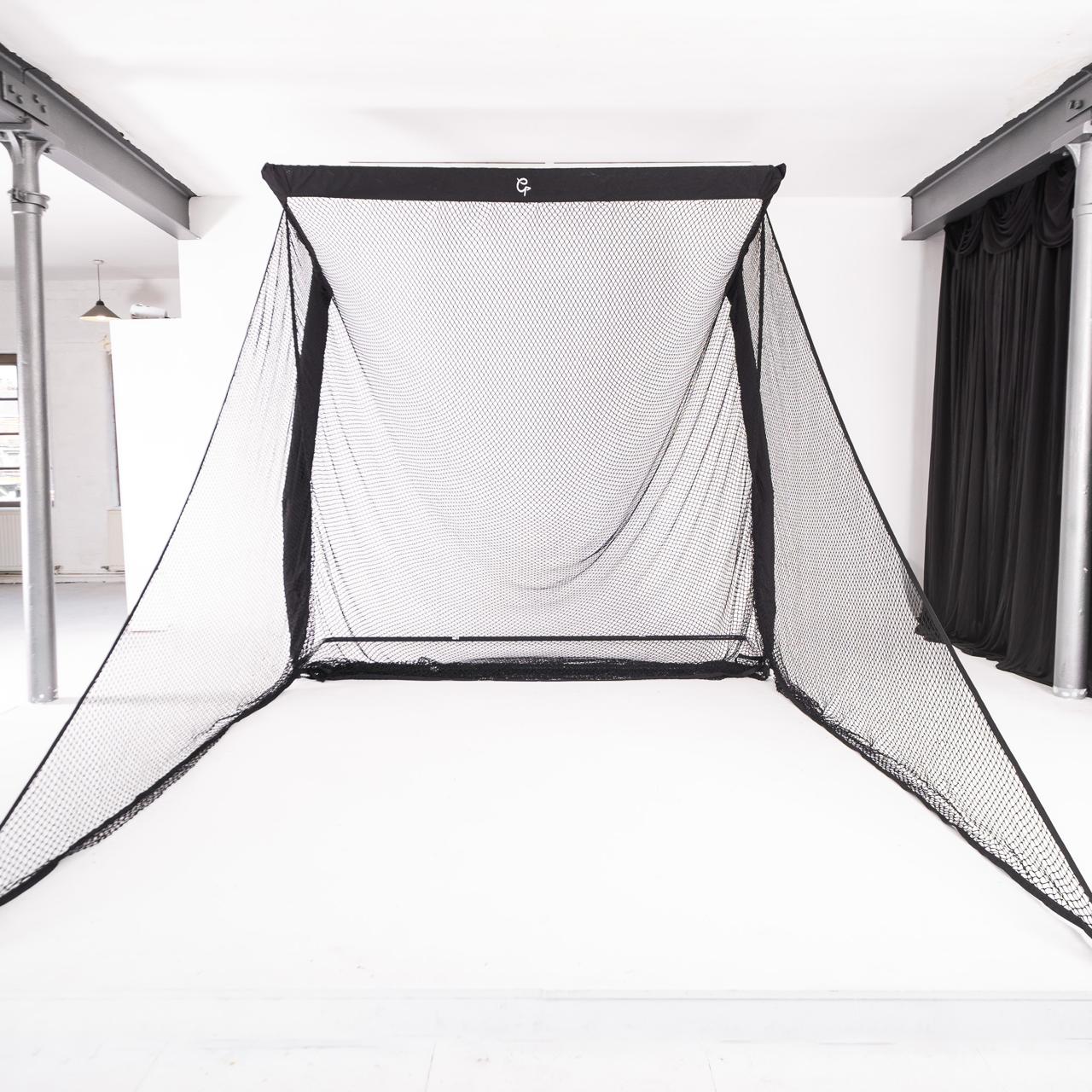
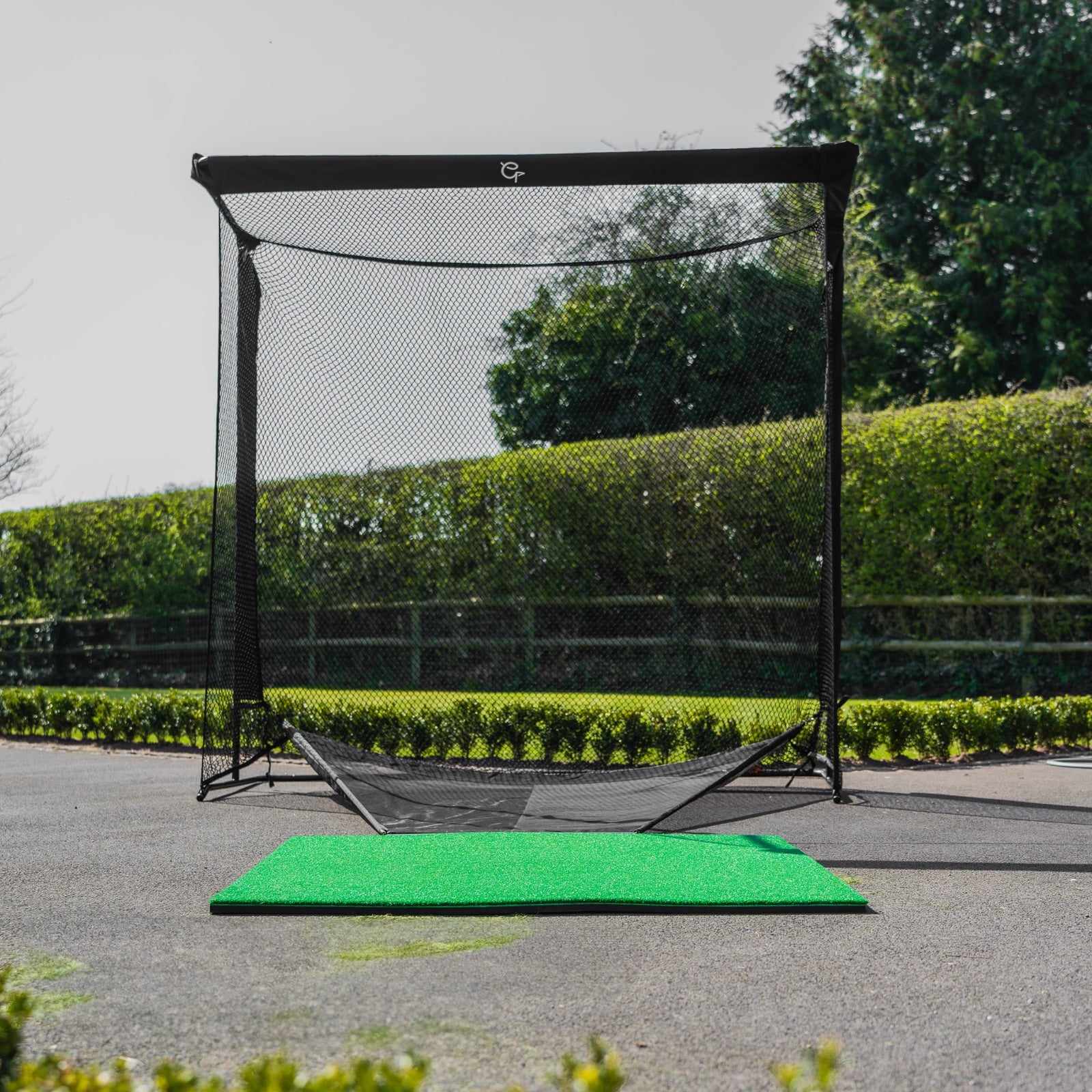
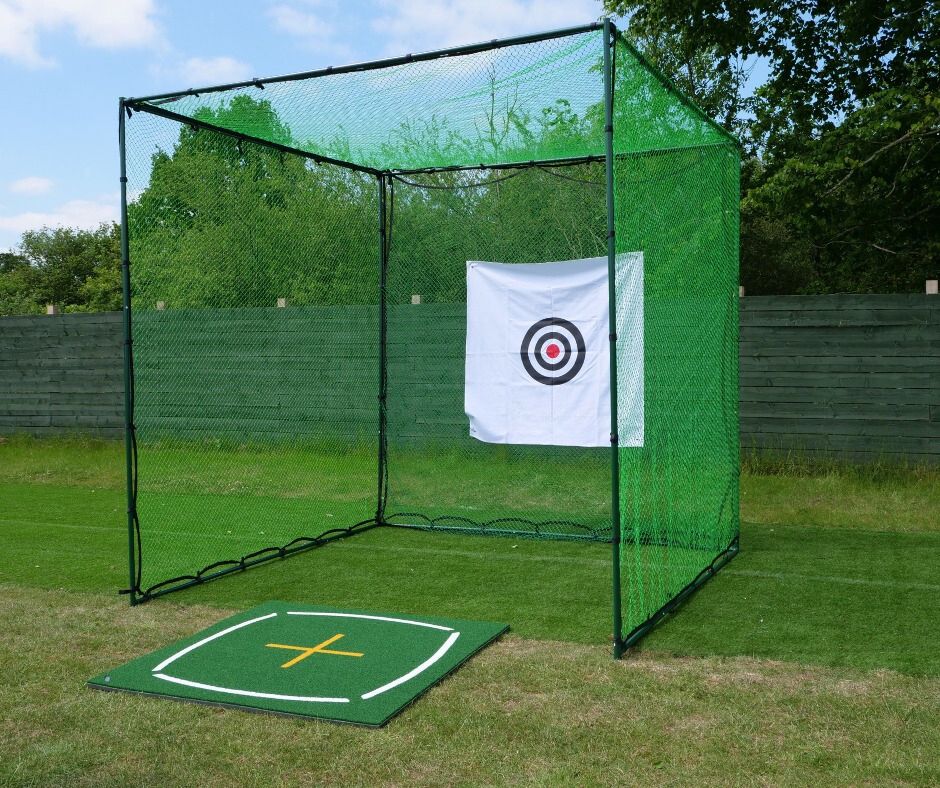
The TrueStrike TS-5 is £229 and weighs about 7.3kg, so it goes back against the side wall when the car comes home. It takes every club, returns the ball to you, and its target takes the edge off the noise of each strike.

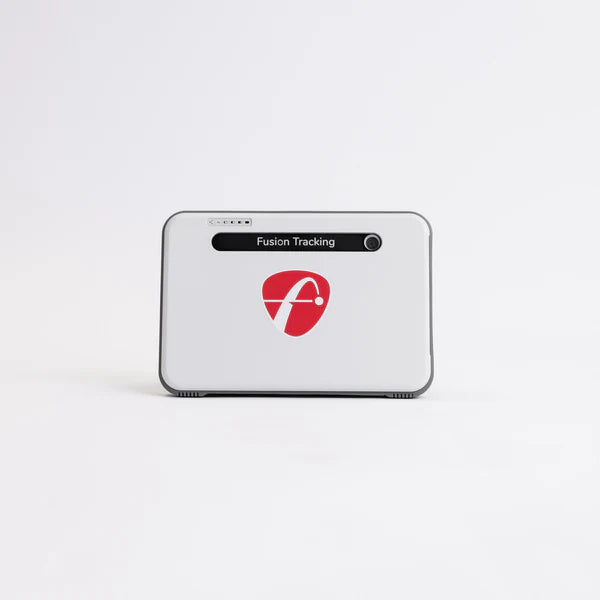
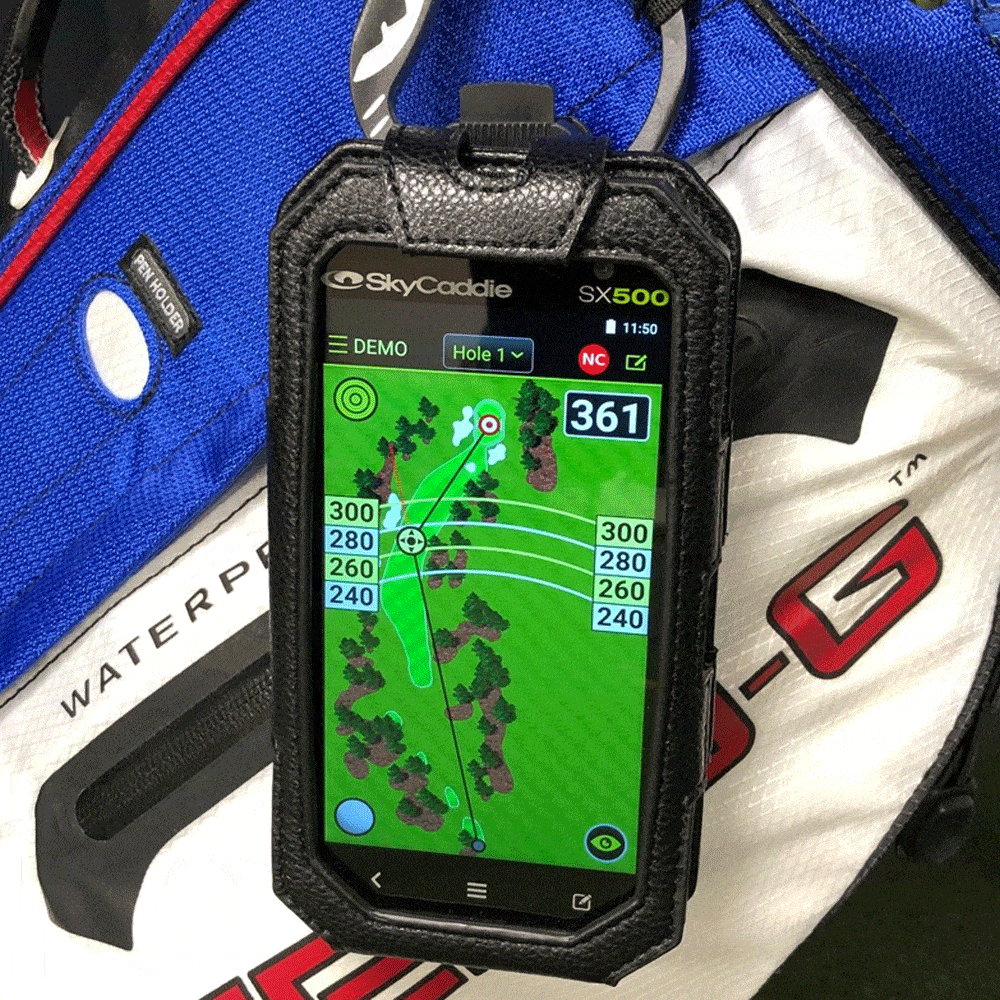
Pair it with the Square Golf launch monitor, which reads the ball and the club with high-speed cameras from beside the ball, with 3D courses and 2 practice modes, Graphical and Data, for £689. It needs nothing behind you, so the depth only has to fit the net and your swing.
Even with its 0.3m roof extension up, the net stands about 2m tall, so it fits a garage too low for a SimBox or an EasySim, and the launch monitor doesn't care how high the room is. Your swing still does, so under 2.8m this is an irons and wedges setup.
The catch: no big picture. The shot plays out on a laptop or tablet beside you rather than on a screen in front of you, which is fine for practice and less fun for 18 holes with your mates.
What fits a double garage?
A double garage opens up 2 more setups: an enclosure that winds up to the ceiling so the car can come back in, and, if the garage is deep enough, a radar launch monitor behind you in a wider SimBox.
Vanish 11 retractable enclosure: room for the car

The Vanish 11 retractable enclosure hangs from universal brackets on the ceiling, with an 11ft (about 3.4m) front screen, 5ft (about 1.5m) side screens and ceiling and corner protection. When you've finished, it winds up to the ceiling, the mat and the launch monitor go to the side, and the floor is the car's again. It's £3,359 with a hand crank, or £4,319 with a remote control.
Hang it against the back wall, away from the door gear. If the garage has more room, there are bigger Vanish models too.
The catch: it's the enclosure only, so the launch monitor, the mat and the projector are extra, and its brackets go into the ceiling, so check what yours is made of before you order.
FlightScope Mevo Gen 2 SimBox package: a deep double garage

If the garage is 5m deep or more, radar opens up. The FlightScope Mevo Gen 2 SimBox package puts FlightScope's radar-and-camera Mevo Gen 2 behind you in a SimBox frame, from £2,250 for the smallest size to £2,650 for the largest, with 8 E6 Connect courses you keep for life.
In a double garage we'd take the 3.6m or 4m width if the room allows, for a wider picture and more space either side of the swing.
The catch: radar needs the depth. In a garage under 5m deep, the SkyTrak ST+ package, with its launch monitor beside the ball, is the better buy.
Not sure what fits your garage?
Send us the height with the door open, the width at the hitting position and the depth to the door, and we'll tell you which bay fits. It's free.
Book a free consultationHow do you stop damp and condensation in a garage simulator?
Stop the kit getting colder than the air around it, keep the air drier, and keep the most valuable bits in the house.
Warmer air holds more water vapour than cooler air, and when air cools to its dew point the vapour condenses back into water (Met Office). In a garage on a winter evening, that happens on your kit. It has sat at close to the outside temperature all day, you switch on a heater, the air warms up quickly, and the projector lens, the PC and the launch monitor stay cold for much longer. The moisture lands on them.
Some of the bay minds more than the rest:
- The projector: a fogged lens blurs the picture, and moisture inside the case is worse.
- The PC or laptop: switching on electronics with condensation on the boards is asking for trouble.
- The launch monitor: usually the most valuable thing in the bay, and small enough to carry.
- The screen and the mat: fabric and turf in a damp room can go mouldy, and a mat on a damp slab stays wet underneath.
The fixes, cheapest first:
1. Measure it. A cheap digital hygrometer shows the humidity in the garage, so you know whether there's a problem before the projector tells you.
2. Run a dehumidifier between sessions through the colder months, and empty it.
3. Keep a little heat in through the winter, so the kit never gets properly cold.
4. Bring the launch monitor and the laptop indoors after every session.
5. Let cold kit warm up before you switch it on, and wait for any fog on a lens to clear.
6. Don't add water. No washing drying on the airer, and a car that comes in wet brings the rain in with it.
7. Fix the building first if water is getting in: damp patches at the base of the walls, puddles, a door seal that's gone. No dehumidifier keeps up with a leak.
Watch out: the blast of heat
A fan heater on full in a frozen garage warms the air long before it warms the kit, and the moisture condenses on the coldest thing in the room, which is often the projector lens. Warm the garage slowly, or keep a low background heat on through the cold months, and switch the electronics on last.
How do you heat a garage golf simulator?
Slowly and safely. The aim is a garage warm enough to swing in and never cold enough for the kit to sweat.
- An electric panel heater or an oil-filled radiator on a thermostat keeps a steady background heat through the winter and doesn't blow dust around the room.
- An infrared panel on the wall warms you and the kit rather than the air, which suits a draughty garage.
- A fan heater is quick for a session, but use it on top of the gentle heat, not instead of it.
- Not a gas or paraffin heater. Burning fuel puts water vapour and fumes into a closed garage, which is the opposite of what the kit needs.
Put the heater on a side wall behind the golfer, well out of the swing and the ball flight. A heater on the ceiling over the mat is a target.
Then keep the heat in, starting with the door: an insulated door, or an insulation kit on the back of an up-and-over door, with draught strips round the edges. Insulating the walls comes next. Insulating the ceiling costs you headroom, so in a low garage do the door and the walls and leave the ceiling alone.
Go further, with a stud wall across the door opening, a window and a radiator, and it's a garage conversion rather than a garage with a simulator in it. Converting a garage, or part of one, into habitable space normally needs building regulations approval (Planning Portal), so talk to building control before the builder starts.
What floor does a garage golf simulator need?
Concrete, which you already have. A slab is firm and doesn't flex, so the mat sits still and a camera launch monitor beside the ball stays level with it.
Concrete gives nothing back, though, which is why a hitting mat on a concrete garage floor needs its own shock layer rather than a thin range-style turf. Before the mat goes down, check 3 things:
- Level: some garage slabs are laid with a slight fall towards the door so water runs out, and a slope under the mat tilts the ball, your stance and the launch monitor. Put a spirit level on it where the mat will go.
- Dry: a slab that goes dark and damp in winter needs sorting before a mat sits on it for months.
- Grip: a mat with a smooth back creeps on smooth concrete, and a painted floor is slippery underfoot.

The GolfBays rubber base grips a smooth slab and holds a 1.5m mat inside its 1.56m frame, so the mat stays where the launch monitor expects it, for £109.
Round the mat, turf over foam underlay makes the rest of the bay kinder to stand on and quieter underfoot, and it covers a shiny floor.
How many sockets does a garage golf simulator need?
Probably more than yours has. Count what plugs in: the projector, the PC or laptop, the launch monitor's charger, a light, a heater and a dehumidifier. That's 6 plugs before anyone wants a kettle.
Put sockets where the kit goes: a socket on the ceiling or high on the wall for a ceiling projector, another at the door end for the PC, and another near the mat for the launch monitor's charger, so no cable crosses the hitting area. Don't run the lot off a chain of extension leads, and give the heater a socket of its own.
In England, electrical work in a home, the garage included, has to meet Part P of the Building Regulations (gov.uk). Adding a socket to an existing circuit isn't notifiable, but a new circuit is, including one that takes power out to a detached garage. Use an electrician registered with a competent person scheme, who can certify the work themselves.
How should you light a garage golf simulator?
Light the golfer, not the screen. The strip light a lot of garages come with lights the room evenly from end to end, screen included, and every bit of light that lands on the screen washes out the picture.
The answer to lighting a garage golf simulator is light over the mat and darkness at the screen end, with the old strip light on its own switch for when you need to find the lawnmower.

Our golf simulator light does the mat end: 1 LED spot on a 1m powered track, aimed down at the ball so a camera launch monitor such as a SkyTrak gets a clear look at it, for £175 in black or white.
Daylight is the other problem. A window, a glazed panel in the door or the gap under it all put light on the screen, so black out the window and fit a brush strip or a seal along the bottom of the door, which stops the draught as well.
How loud is a golf simulator in a garage?
Louder than you'd think. A club on a mat and a ball into a screen make a thwack that carries through a party wall, and a metal garage door can rattle along with it.
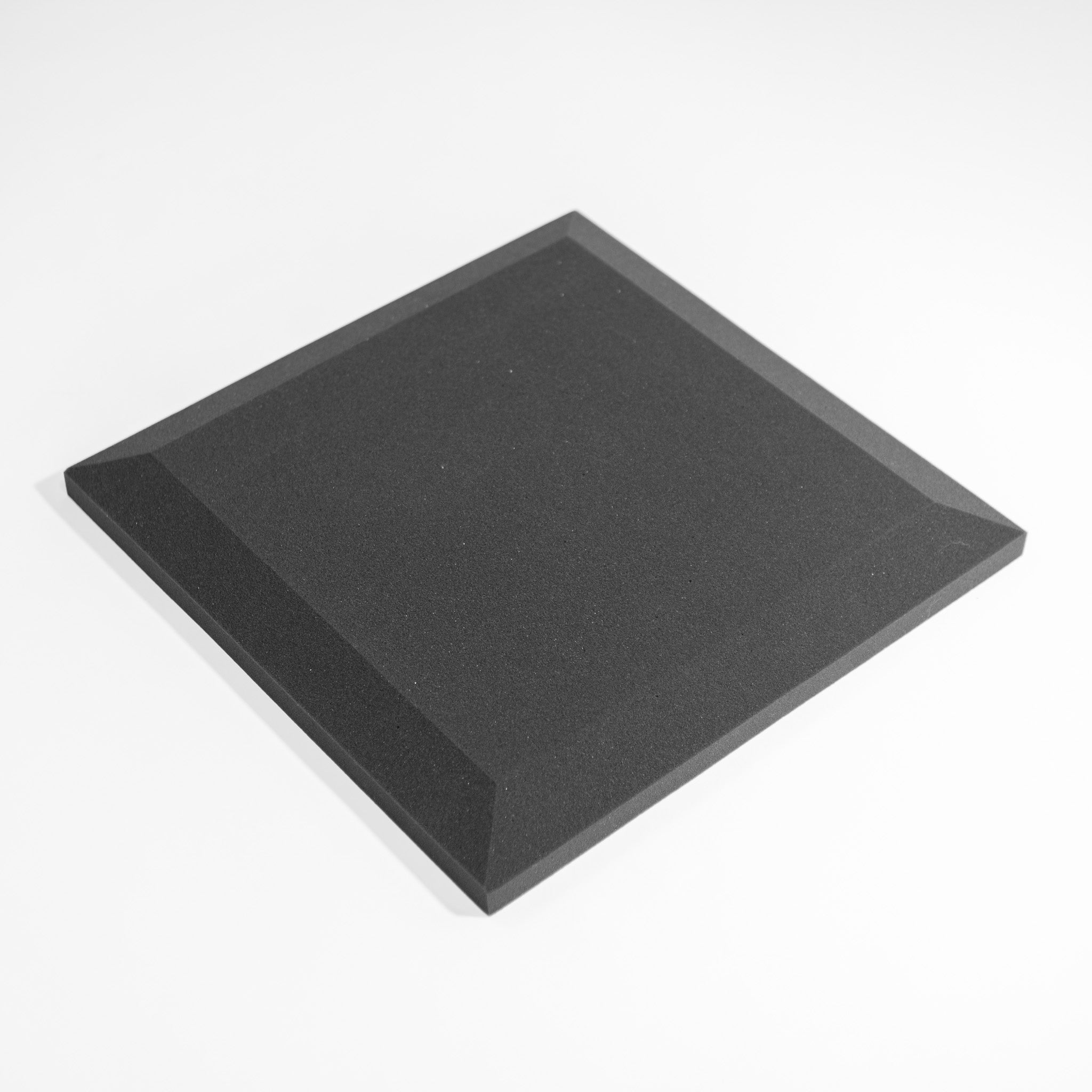
Bare block walls make it worse, because the sound bounces round the room. Acoustic foam on the walls beside and behind you takes the echo out.

Our diamond acoustic wall tiles are £74.99 for a pack of 10 foam squares, 50cm a side, and spray glue puts them straight onto the blockwork.
A quieter screen helps at the source too, and the EasySim's Lite screen is made for a quiet impact. The neighbours will forgive a lot, but maybe not a 10pm driver session through the bricks.
How do you keep a garage simulator secure?
Treat it like the most valuable thing in the garage, because it probably is.
- Take the portable kit in. The launch monitor and the laptop come into the house after every session.
- Lock the door properly. Fit a second lock or a garage door defender, the lockable post that stops an up-and-over door being lifted.
- Keep it out of sight. A lit screen with the door up at dusk tells everyone on the street what's inside.
- Tell your insurer. Ask whether kit in the garage is covered the same way as kit in the house, and list the launch monitor and the projector by name.
GolfBays tip
Photograph the serial numbers on the launch monitor, the projector and the PC when you unpack them, and keep the photos with the receipts. It's a quick job, and it means you can tell an insurer or the police exactly what was taken.
How much does a garage golf simulator cost?
From £1,649 for the cheapest complete package, before anything the garage itself needs. These are GolfBays prices on 30 September 2026.
| Setup | What's in it | Price |
|---|---|---|
| TrueStrike TS-5 net and Square Golf launch monitor | Net and camera launch monitor, packs away | £918 |
| Square Golf EasySim package with a mat | Enclosure, screen, launch monitor and mat | £1,849 |
| FlightScope Mevo Gen 2 SimBox package | Enclosure, screen and radar launch monitor | £2,250–£2,650 |
| SkyTrak ST+ SimBox package | Enclosure, screen, launch monitor and mat | £2,490–£2,890 |
| Vanish 11 retractable enclosure | Retractable enclosure only | £3,359–£4,319 |
Every enclosure setup needs a projector as well, and the garage may need sockets, heating, insulation or work on the door. Those depend entirely on your garage, so get 2 or 3 local quotes.
When is a garage the wrong room?
When it fails on height, water or the car, and no amount of kit will fix it:
- The ceiling is under 2.8m and you won't give up the driver. Under 2.5m, no SimBox or EasySim frame fits either.
- Water gets in, and the building needs fixing before anything electronic moves in.
- The car goes back in every night, there's no room for an enclosure that winds up out of its way, and a net with the shots on a tablet isn't the simulator you had in mind.
When the garage won't do, a golf simulator cabin in the garden is built around the bay from the start, at garden-room prices rather than garage ones. And from spring to autumn, a net and a launch monitor in the garden gets you hitting and leaves the garage to the boxes.
Garage golf simulator FAQs
How much does it cost to put a golf simulator in your garage?
From £1,649 for the Square Golf EasySim package, or about £3,100 with a mat, a floor-standing projector and acoustic tiles. Add whatever the garage itself needs, such as sockets, heating and insulation, which varies from garage to garage.
Can I set up a golf simulator in my garage?
Yes, if it's about 2.8m high with the door open, 3m wide and 4.5m deep for a camera launch monitor beside the ball, or 5m deep for radar. A lower garage still takes a net and a camera launch monitor for irons and wedges.
What is the best golf simulator for a garage?
For a single garage 3m wide, the SkyTrak ST+ SimBox package: its launch monitor sits beside the ball, so 4.5m of depth is enough. If the car still has to fit, the Vanish 11 retractable enclosure winds up to the ceiling when you're done.
How can I convert my garage into a golf simulator?
Clear it, fix any damp, sort the sockets and the heating, then put the bay at the back wall and hit away from the door. You don't have to convert the garage into a habitable room to put a simulator in it. If you do go that far, planning permission isn't usually needed for internal work, but some homes, particularly on new housing developments and in conservation areas, have had those rights removed, so check with the council first (Planning Portal).
How big of a garage do I need for a golf simulator?
At least 3m wide, 2.8m high and 4.5m deep for a full swing with a camera launch monitor, or 5m deep with radar. The EasySim needs 3.3m of width, and every SimBox and EasySim frame is at least 2.5m tall.
What is the cheapest setup for a golf simulator?
A net, a mat and a launch monitor, with the shots on a laptop or tablet rather than a big screen. In a garage that still has to take the car, the pack-away bay we'd pick, a TrueStrike TS-5 net and a Square Golf launch monitor, comes to £918 before the mat. Our cheapest complete simulator, with an enclosure and a screen, is the Square Golf EasySim package at £1,649.
Is an 8ft ceiling enough for a golf simulator?
In a garage it usually means irons and wedges only. 8ft is about 2.4m, 40cm short of the 2.8m we plan on for a driver, and every SimBox and EasySim frame is at least 2.5m tall, so an 8ft garage takes a net rather than an enclosure. Measure under the open door as well, because the door gear often sits lower than the ceiling.
What type of flooring is best for a golf simulator?
In a garage, the slab you already have is the base. Check it's level and dry, then either sit a proper hitting mat in a non-slip rubber base, or set it into foam underlay and turf that cover the rest of the bay.
Kit out your garage
Practice nets that pack away and retractable enclosures that lift out of the car's way, for single and double garages.
See garage golf simulators